Tag Archives: Jesus christ

Endure Until the End: A Message to God’s Faithful Servants During Spiritual Warfare and Tribulation

Greetings my dear brothers and sisters in Christ from all around the world. I wanted to share a short message. As I reflected on a few things, I felt moved to share a message with the faithful to keep enduring through any hardships or suffering you may be facing right now. My hope is that you remain strong during times of conflict. Many of us are experiencing intense spiritual battles, which may look different for each of us. We might be struggling in various areas of our lives, but God is guiding us through the Great Tribulation.

Revelation 12 presents a spiritual conflict involving the dragon, Michael and his angels, and people who remain faithful to God.

“And there was war in heaven: Michael and his angels fought against the dragon; and the dragon fought and his angels, And prevailed not; neither was their place found any more in heaven.” – Revelation 12:7–8 (KJV) Then the dragon turns his attention toward God’s people: “And the dragon was wroth with the woman, and went to make war with the remnant of her seed, which keep the commandments of God, and have the testimony of Jesus Christ.” — Revelation 12:17 (KJV)

In those verses you can see that it describes spiritual warfare against faithful servants of God. Those who have been faithful are called the 144,000. “Here is the patience of the saints: here are they that keep the commandments of God, and the faith of Jesus.”— Revelation 14:12 (KJV) We know through scripture that the 144,000 are sealed as belonging to God and the Lamb. Daniel 12 portrays Michael as the great prince who stands for God’s people during an unparalleled time of trouble. Well once God’s people began awakening spiritual warfare increased.

And at that time shall Michael stand up, the great prince which standeth for the children of thy people: and there shall be a time of trouble, such as never was since there was a nation even to that same time: and at that time thy people shall be delivered, every one that shall be found written in the book.” — Daniel 12:1 (KJV)

During the Great Tribulation, God’s sealed servants stay under His divine protection as they face spiritual opposition. Many of us have experienced this, and God has continued to shield us even in the midst of intense spiritual warfare. This battle has been ongoing and many of us are exhausted. Many of us at times feel like giving up because it seems like it’s just one thing after the other and at times we just don’t know what to do. Many of us have cried out to God and have asked for our deliverance because we want this war to end for good, at least I do. We strive to live in holiness and righteousness, and most of us mind our own business, yet some still face hardship. In times of trouble, we must remain patient, hold on to hope, and keep praying. Brothers and Sisters try to hold on no matter what because God is with us until the end. Even though we have protection it doesn’t mean that we won’t experience spiritual warfare.

This is why we have to endure through the spiritual warfare and remain strong. You can do this. You are not alone. I am here with you enduring through spiritual warfare. IIt’s not easy at all, but I believe God has been protecting me. Sometimes I get scared because there are days when I have no idea what the outcome will be. I just keep praying and hoping I can make it through. The world is changing, and so many people are struggling in different parts of their lives—whether in relationships, finances, or health. Humanity is under attack, with so much happening that makes life hard for everyone. We are living in a world where many people are lawless and they don’t have respect for life at all. God’s people have to be the light in the world. We have to be the lighthouse.

Keep doing what’s right and holy in the sight of the Most High. God sees everything you do, and nothing goes unnoticed. Remember, He is always with you. Keep praying for your brothers and sisters in Christ around the world. Ask God to continue sending His angels to guard us each day. Pray that we stay on the narrow path and remain strong through trials and tribulations. Ask Him to keep giving you strength and keep your lamp burning for God. Until we are gathered I leave you in the light and love of the One Infinite Creator. I love you all! We can do this. Know that help is on the way. – Seraphim Sophia

Decoding the Mysteries of My March 21, 2018 Vision: Spring, Passover, and Israel’s Season of Deliverance

Shalom brothers and sisters in Christ from all around the world. I will continue my series of the revelation that was hidden in my dream. Please see other posts.

Preparation for the Wedding Feast: Yahshua Visits Me in a Vision, Riding a White Horse and Clothed in a White Linen Robe

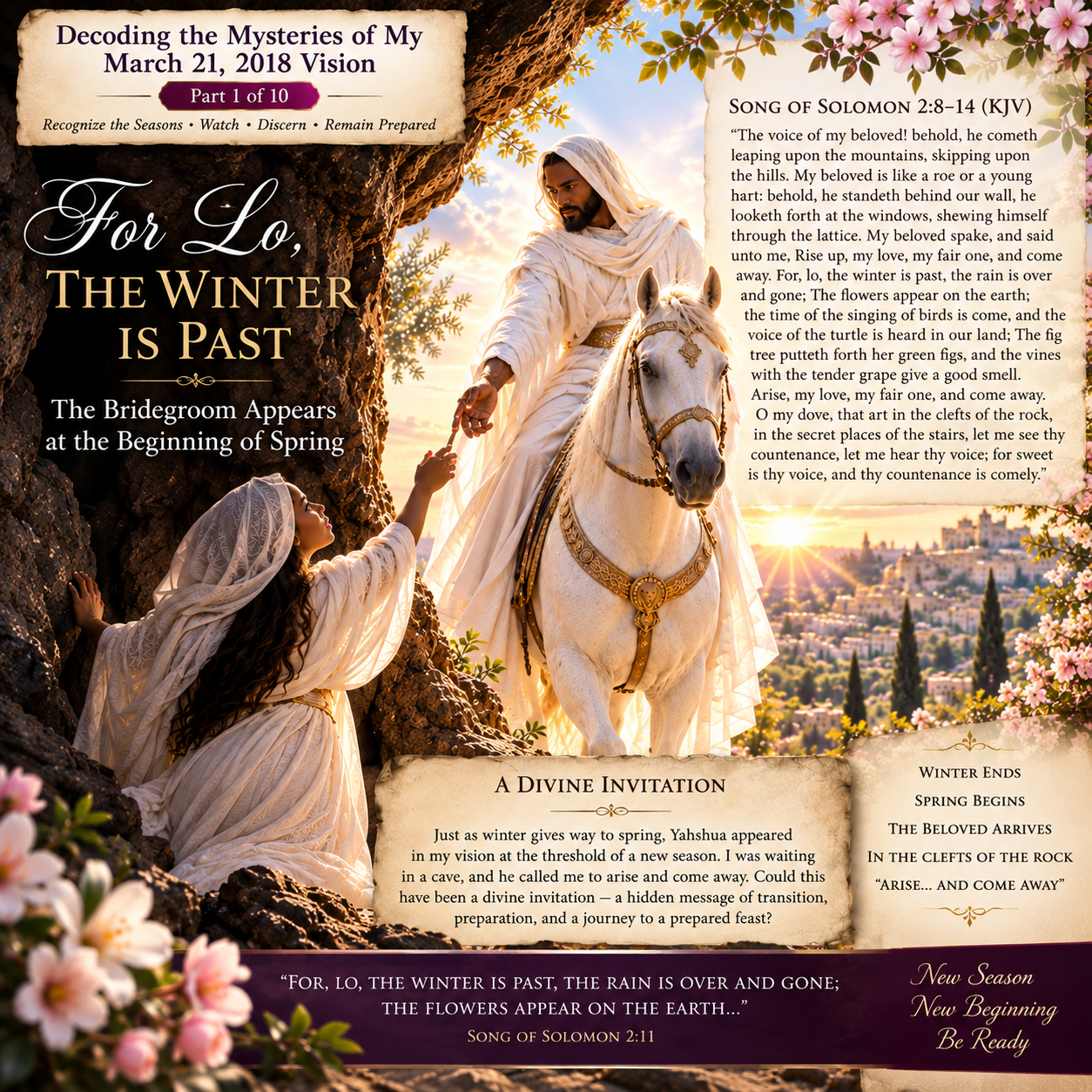
Decoding the Mysteries of My March 21, 2018 Vision: “For Lo, the Winter Is Past” — The Bridegroom Appears at the Beginning of Spring!

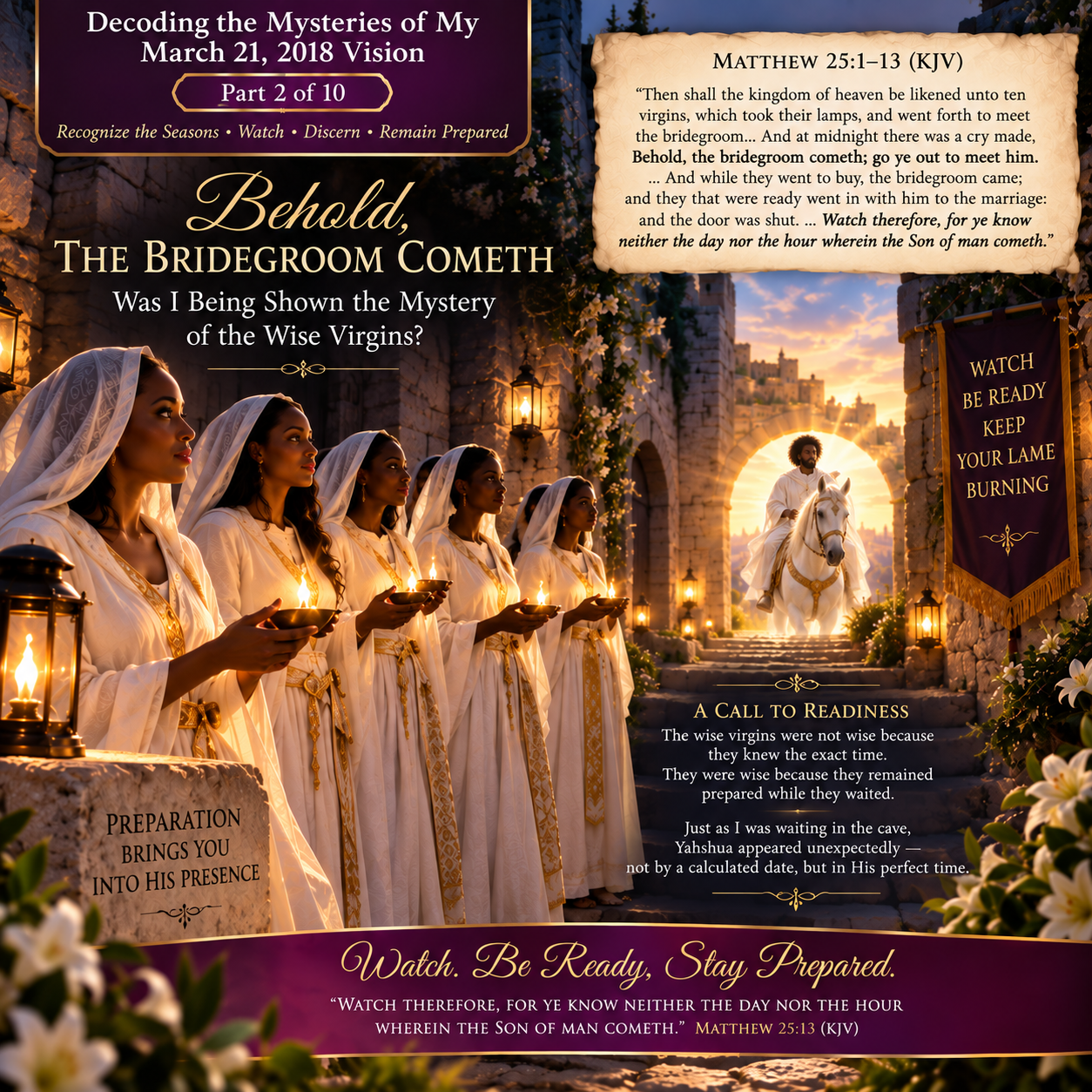
Decoding the Mysteries of My March 21, 2018 Vision: “Behold, the Bridegroom Cometh” — Was I Being Shown the Mystery of the Wise Virgins?

In this post, I won’t be continuing the original dream as in previous entries, so I hope the other posts are read to fully grasp the message. As I reflected more on my dream, the arrival of spring revealed even more messages from God, pointing me toward the Spring Feasts. I also realized He visited me on the first day after the Spring Equinox. From the dream, I could see a clear transition from winter into the new season of spring.

The Spring Appointed Times: Deliverance, Firstfruits, and the Beginning of the Harvest

When I look more closely at the biblical calendar, spring carries profound meaning. Leviticus 23 places Passover, the Feast of Unleavened Bread, Firstfruits, and the Feast of Weeks within this opening portion of Israel’s sacred annual cycle. Together, these appointed times form a progression involving deliverance, separation, firstfruits, harvest, and gathering.

Passover and Unleavened Bread — Leviticus 23:4–8

“These are the feasts of the LORD, even holy convocations, which ye shall proclaim in their seasons. In the fourteenth day of the first month at even is the LORD’S passover. And on the fifteenth day of the same month is the feast of unleavened bread unto the LORD: seven days ye must eat unleavened bread. In the first day ye shall have an holy convocation: ye shall do no servile work therein. But ye shall offer an offering made by fire unto the LORD seven days: in the seventh day is an holy convocation: ye shall do no servile work therein.”
Leviticus 23:4–8 (KJV)

Passover commemorates the great deliverance of the children of Israel from Egypt. It marked a threshold: Israel was leaving bondage behind and beginning a new journey with the Most High. In my own spiritual journey, I experienced a profound transition from my old life into what I understood as a new life in Christ. On July 2, 2012, I rededicated my life to Christ, and that moment became a turning point in my life. I experienced what I understood as deliverance from spiritual bondage, and during that first week, it felt as though God was renewing my mind and changing me from within. In many ways, it felt as though my old self had died and I was awakening into a new life.

During the intense experience that preceded my spiritual awakening and deliverance, there were moments when everything seemed to go completely blank. At times, it felt as though I temporarily lost consciousness. There was darkness—moments when I could not remember anything and everything seemed to become pitch black. In my subconscious, it felt like I had sunk into an underworld or drifted through a realm of total darkness and unconsciousness. I remember wondering afterward if I had died momentarily, because at that particular time, I honestly could not tell what had happened to me. I experienced what felt like coming out of my body, and there was a period of missing time that I could not account for. I had been awake, and then suddenly I lost consciousness. I do not remember the transition from being conscious to losing consciousness, nor can I recall what happened during the period of time that followed.

When I finally woke up, I found myself in another location inside the hospital, surrounded by members of my family. I was taken to the hospital on July 4. I remember being awake before everything went blank, and I remembered waking up afterward, but everything that occurred between those two moments was missing from my memory. I’m not exactly sure what was happening during those three days—July 4, 5, and 6—but symbolically, the experience felt like death, deliverance and resurrection to me. My memories slowly started coming back on the Sabbath, Saturday, July 7, 2012. The darkness felt like the ending of my former life, while the gradual return of consciousness felt like an awakening—a revival and emergence from darkness into light.

As I became fully conscious again, I experienced it as though God were bringing me back to life. My mind was renewed and there was clarity. I felt that I had been given a new beginning and a second chance at life. The person I had been before seemed to be passing away, while something new was awakening within me. Looking back, this experience reminds me of Paul’s words:

“Therefore if any man be in Christ, he is a new creature: old things are passed away; behold, all things are become new.” — 2 Corinthians 5:17 (KJV)

That scripture beautifully captures what the experience came to mean for me, the old life fading away and a new life beginning in Christ. I knew afterward that I wanted to dedicate my life to serving the Most High. I felt that I had been redeemed, awakened, and given another opportunity to live differently. What began in darkness ultimately became, for me, a journey toward light, away from my former life and toward cleansing, transformation, spiritual renewal, and a deeper relationship with God.

When I reflect on Passover and the Exodus it represents deliverance, departure, transition, and a new beginning. On my journey God always led me to the Book of Exodus. Spring was the season of Israel’s deliverance, as described in Exodus 12:1–14. The Exodus was more than just an escape from Egypt; it marked the start of a whole new chapter in Israel’s relationship with God. In the same way, when I was delivered, it signified a fresh beginning in my own relationship with God. In this way, I transitioned from bondage into deliverance.

Then suddenly I moved from deliverance to the beginning of harvest which now we arrive to Firstfruits — Leviticus 23:9–14

“And the LORD spake unto Moses, saying, Speak unto the children of Israel, and say unto them, When ye be come into the land which I give unto you, and shall reap the harvest thereof, then ye shall bring a sheaf of the firstfruits of your harvest unto the priest: And he shall wave the sheaf before the LORD, to be accepted for you: on the morrow after the sabbath the priest shall wave it. And ye shall offer that day when ye wave the sheaf an he lamb without blemish of the first year for a burnt offering unto the LORD. And the meat offering thereof shall be two tenth deals of fine flour mingled with oil, an offering made by fire unto the LORD for a sweet savour: and the drink offering thereof shall be of wine, the fourth part of an hin. And ye shall eat neither bread, nor parched corn, nor green ears, until the selfsame day that ye have brought an offering unto your God: it shall be a statute for ever throughout your generations in all your dwellings.”
Leviticus 23:9–14 (KJV)

Firstfruits capture another key theme of spring: new growth begins to push through the soil, and the first portion of the coming harvest is given as an offering to God. I suppose God was showing me that I was a part of this coming harvest. In my dream, I saw a sign that winter had ended and spring had arrived. My deliverance came in the form of Yahshua returning on a white horse, dressed in fine white linen. Spring, with its fresh blooms and new life, marked the appearance of the firstfruits and the beginning of the harvest. According to the dream it’s possible I represented the firstfruit and the beginning of the harvest. I say this because he led me to a feast where I had a seat at the banquet table. In my dream, there was mention of the Bride, and he had asked me to be her. It all pointed to Revelation 19, where I would symbolize the Bride preparing herself, though we know this refers to God’s holy people. This leads to the 144,000 as the representation of the Bride.

During the first week of my spiritual awakening and deliverance, I entered into what I experienced as a trance-like state, and my mind felt caught up toward God. During that experience on July 3, 2012, I remember speaking about the 144,000—the 12,000 from each of the twelve tribes of Israel—and sensing that the inner transformation I was experiencing would not be mine alone. I understood what was happening within me as part of a much greater spiritual awakening and transformation. I wasn’t going to be the only one going through an awakening.

On that day I did not know that I was about to undergo an intense process of cleansing, purification, and spiritual transformation. During the trance, I understood the experience as a revelation that I was among the 144,000. This became deeply significant to my spiritual journey and influenced how I later understood the biblical passages concerning the 144,000. Revelation first describes the 144,000 in connection with the twelve tribes of Israel: And I heard the number of them which were sealed: and there were sealed an hundred and forty and four thousand of all the tribes of the children of Israel.” — Revelation 7:4 (KJV)

Revelation 7:5–8 lists 12,000 sealed from each of the twelve named tribes, adding up to a total of 144,000. The passage that most clearly links the 144,000 to the concept of redemption and firstfruits is found in Revelation 14. “And I looked, and, lo, a Lamb stood on the mount Sion, and with him an hundred forty and four thousand, having his Father’s name written in their foreheads.” — Revelation 14:1 (KJV) Then Revelation explains who they are: “These are they which follow the Lamb whithersoever he goeth. These were redeemed from among men, being the firstfruits unto God and to the Lamb. And in their mouth was found no guile: for they are without fault before the throne of God.” — Revelation 14:4–5 (KJV)

The phrases that really stand out to me are: “Redeemed from among men” and “The firstfruits unto God and to the Lamb.” This adds a new layer to the symbolism of firstfruits. Revelation 14 depicts the 144,000 as “the firstfruits to God and to the Lamb.” During my awakening and deliverance, I realized that God had redeemed me. It hit me many years later that I was one of the redeemed ones. I was presented as one of the firstfruits to God and the Lamb.

Looking back upon what I experienced during that first week of my awakening, I understood my deliverance as coming out of bondage, leaving my old life behind, awakening from darkness, and beginning a new life dedicated to God. During the trance, I understood that the transformation taking place within me was connected to a larger body of people who would also undergo a process of spiritual preparation and transformation. I committed myself to doing the inner work, allowing the Holy Spirit to cleanse, refine, and transform me from within. I understood this process as preparation for ascension and, ultimately, for being part of the great harvest at the end of the age. From my point of view, what I had been learning in biblical prophecy was becoming real and personal, I felt like I was watching it happen in real time and that my own spiritual journey was somehow connected to it.

I’ve come to see myself as one of the Firstfruits, part of the 144,000 who are sealed and belong to God and to Yahshua. We, as the Bride of Christ, symbolize the start of the harvest, but more people will join us, following our example. They too will become faithful servants, just as we have. In the end, there will be a greater harvest, and that is when we will all be gathered together. That will represent the final gathering, the end of the great harvest.

So my dear brothers and sisters Revelation 14 highlights the close relationship between the 144,000 and the Lamb. They stand alongside Him, bear the Father’s name, follow wherever He goes, have been redeemed, are known as firstfruits, and live lives marked by faithfulness. The final message is to remain set apart because you don’t know the final timing of great harvest. When the full number has been reached for the harvest, I suppose that’s when Yahshua will send the angels to gather the elect, all of God’s faithful servants. -Seraphim Sophia

Decoding the Mysteries of My March 21, 2018 Vision: “Behold, the Bridegroom Cometh” — Was I Being Shown the Mystery of the Wise Virgins?

Shalom Brothers and Sisters of Christ from all around the world. Please see previous post Decoding the Mysteries of My March 21, 2018 Vision: “For Lo, the Winter Is Past” — The Bridegroom Appears at the Beginning of Spring!

In my dream I was called to a cave and there I waited for the arrival of Yahshua. Then he appeared. I had previously experienced Yahshua telling me in separate dream that he would return to me. In that dream, I was caught up in a whirlwind and there I appeared inside of a chariot, a heavenly ship above the Earth in space. At the end of our time together on the ship, he told me he would return the next day. After the dream, I waited for his return, unsure of the exact time. Some time passed before he appeared to me unexpectedly in another dream.

In the vision, I stood waiting inside a cave, and when I was called there, Yahshua himself gave me a code to identify him by. When I emerged from the cave, I saw it was truly him on the white horse. He dismounted, took my hand, and led me to a feast. I had been waiting for years, since my last encounter with him on the chariot, not knowing exactly when Yahshua, the Bridegroom, would appear. During that time, I learned to stay watchful. It was all about being ready and prepared for the moment the bridegroom finally arrives. I have been waiting for Yahshua for a long time, and during that period, I became a wise virgin. On my journey, I learned the parable of the ten virgins. The key lesson isn’t about knowing the exact time, but about being prepared before the bridegroom arrives unexpectedly.

“Behold, the Bridegroom Cometh” — Matthew 25:1–13

“Then shall the kingdom of heaven be likened unto ten virgins, which took their lamps, and went forth to meet the bridegroom. And five of them were wise, and five were foolish. They that were foolish took their lamps, and took no oil with them: But the wise took oil in their vessels with their lamps. While the bridegroom tarried, they all slumbered and slept. And at midnight there was a cry made, Behold, the bridegroom cometh; go ye out to meet him. Then all those virgins arose, and trimmed their lamps. And the foolish said unto the wise, Give us of your oil; for our lamps are gone out. But the wise answered, saying, Not so; lest there be not enough for us and you: but go ye rather to them that sell, and buy for yourselves. And while they went to buy, the bridegroom came; and they that were ready went in with him to the marriage: and the door was shut. Afterward came also the other virgins, saying, Lord, Lord, open to us. But he answered and said, Verily I say unto you, I know you not. Watch therefore, for ye know neither the day nor the hour wherein the Son of man cometh.

As I reflect upon this experience even further, I realize that I was already waiting for Yahshua, much like the wise virgins who waited for the Bridegroom. When he came unexpectedly, I was ready to go with him. And when he led me to the feast, everything had already been prepared. Before this vision, when I met with Yahshua aboard the celestial vessel, he told me that he would return to me tomorrow. Afterward, I thought deeply about the words he spoke to his disciples:

John 14:3: “And if I go and prepare a place for you, I will come again, and receive you unto myself; that where I am, there ye may be also.”

I held this verse close to my heart. I believed that Yahshua would come again, and I wanted to remain ready for whenever that moment came. In my heart, the promise of his return became connected with the hope of joining him at the wedding feast prepared for the Bride. The parable of the wise virgins takes on even greater meaning for me when I look back upon these experiences. The wise virgins were not wise because they calculated when the Bridegroom would arrive. They were wise because they remained prepared while they waited. Their lamps were burning and they had oil with them. When the Bridegroom suddenly appeared, they were ready to go with him.

I also remember another spiritual experience when I was caught up in the Spirit and heard a voice say, “Do not become distracted!” Those words remained with me. I understood them as a reminder to remain focused upon God and upon the spiritual work taking place within me rather than allowing the distractions of the world to pull me away from that path. I had also received a message that after being cleansed, I needed to keep my robe clean. That became deeply meaningful to me. I understood the robe symbolically as representing my spiritual condition before God. If God was cleansing, purifying, and refining me, then I wanted to remain on the narrow path and guard what had been entrusted to me. I wanted to live set apart, continually examining my heart and allowing God to continue transforming me.

In many ways, it felt as though I hid myself away from the world for a season so that I could concentrate upon that cleansing and purification. I desired solitude with the Most High. I wanted to spend time alone with God to pray, seek, learn, heal, change, and allow Him to transform me from within. I dedicated my life to the Most High because I wanted my heart, mind, and spirit to remain centered upon Him. Looking back, I can now see why the imagery of the wise virgins, the clean garment, the Bride, and the prepared wedding feast resonates so strongly with my March 21, 2018 vision. The message I draw from all of these experiences is not about calculating when the Bridegroom will arrive. It is about what we are doing while we wait. So to all my sisters and brothers in Christ, keep your lamp burning and your robe clean. Stay focused and walk the narrow path. Let God continue to cleanse, purify, and refine you. When the Bridegroom arrives, be ready to go with Him. -Seraphim Sophia

Decoding the Mysteries of My March 21, 2018 Vision: “For Lo, the Winter Is Past” — The Bridegroom Appears at the Beginning of Spring!

Shalom, brothers and sisters in Christ from around the world. I’m delving deeper into the dream I was given, searching for hidden clues and signs within it. It is possible that Yahshua was sending me a hidden message through my dream—something encoded within the timing, setting, symbols, and sequence of events that I did not fully recognize when the vision occurred. Do you notice anything that I cannot yet see? As I reflect upon my March 21, 2018 vision, I am beginning to recognize layers of biblical symbolism that I did not recognize when the vision originally occurred. What especially captures my attention now is not merely what happened in the vision, but when it happened and the order in which everything unfolded.

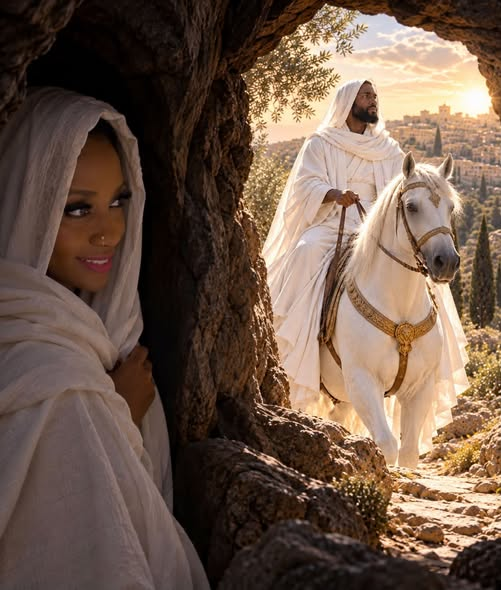
The vision occurred immediately after the transition from winter into spring. I was waiting inside a cave in an ancient land. Yahshua arrived riding a white horse and clothed in white linen. I came out from the cave, verified the private sign that allowed me to recognize him, and knew that it was safe to go with him. He descended from the horse, took me by the hand, and led me toward a prepared banquet table. I sat at the table while he prepared my meal. It felt as though I had been brought to a sacred wedding feast. Looking back, I wonder whether the mystery is contained not within any single symbol, but within the sequence:

The old season ended. → A new season began. → I waited within the rock. → The Bridegroom appeared. → I came out of concealment. → His identity was confirmed. → He took me by the hand. → I followed him. → He brought me to a prepared table.

That sequence makes me think differently about the dream. Perhaps the seasonal timing itself was part of its symbolism. Perhaps winter ending and spring beginning represented a transition from waiting into fulfillment, concealment into revelation, dormancy into awakening, and death-like stillness into new life. Spring is closely tied to Israel’s biblical story, marking Passover, the Exodus, deliverance, firstfruits, themes of resurrection, and the beginning of the harvest.

I am not trying to calculate the actual day or hour of Yahshua’s return. The precise time is not ours to know but scripture repeatedly teaches us to watch, recognize the season, remain spiritually awake, and be prepared. That distinction is important as I continue discerning what this vision meant to me. I discovered something I had not recognized in 2018: Song of Solomon 2 describes an astonishingly similar sequence. The beloved approaches precisely when winter has ended. Spring has arrived. The fig tree begins producing fruit. The woman is found “in the clefts of the rock,” and her beloved calls to her. In the dream I was waiting in a cave.

“The Winter Is Past” — Song of Solomon 2:8–14 : “The voice of my beloved! behold, he cometh leaping upon the mountains, skipping upon the hills. My beloved is like a roe or a young hart: behold, he standeth behind our wall, he looketh forth at the windows, shewing himself through the lattice. My beloved spake, and said unto me, Rise up, my love, my fair one, and come away. For, lo, the winter is past, the rain is over and gone; The flowers appear on the earth; the time of the singing of birds is come, and the voice of the turtle is heard in our land; The fig tree putteth forth her green figs, and the vines with the tender grape give a good smell. Arise, my love, my fair one, and come away. O my dove, that art in the clefts of the rock, in the secret places of the stairs, let me see thy countenance, let me hear thy voice; for sweet is thy voice, and thy countenance is comely.”In my vision, winter fades and spring begins. I wait in a cave among the rocks until Yahshua arrives. I recognize him instantly, step out of the cave, and take his hand. Together, we walk as he leads me to a feast.

In the Song of Solomon, winter fades and spring emerges, the beloved arrives, the woman is sheltered in the clefts of the rock, and the beloved calls to her, saying, “Rise up… and come away.” What especially amazes me is that my dream occurred on March 21, immediately after the spring equinox. I did not recognize all these connections back in 2018. Looking back, however, I see beautiful symbolism in the Bridegroom appearing as winter gives way to spring and calling the beloved out from the rock to accompany him.

Dear brothers and sisters in Christ, stay grounded in God, remain alert, notice the shifting seasons, and do not follow blindly. Know the Bridegroom and be prepared for his arrival. When he calls, step forward, take his hand, and go where he leads—the feast is already prepared. – Seraphim Sophia

Preparation for the Wedding Feast: Yahshua Visits Me in a Vision, Riding a White Horse and Clothed in a White Linen Robe

Shalom, brothers and sisters in Christ from all around the world. May peace be with you all. I wanted to share a beautiful vision that has remained deeply etched in my mind throughout the years. The vision occurred on Wednesday, March 21, 2018, at the very beginning of spring—the day after the spring equinox on March 20. Looking back at the timing adds another beautiful layer of symbolism to the experience. The spring equinox marks a threshold between seasons. Day and night come into balance, winter comes to an end, and a new season of increasing light, renewal, growth, and new life begins. Seasonal thresholds such as the equinox can be contemplated symbolically as gateways—moments of transition from one cycle into another. My vision occurred immediately after that threshold, as the season of spring had begun.

In the vision, Yahshua visited me riding upon a white horse, clothed in a beautiful white linen robe. The image of him approaching me in this way is something I have never forgotten. I was inside a cave in an ancient land, at a place where Yahshua had instructed me to meet him. The cave itself felt significant. Symbolically, a cave can represent a hidden or protected place—a place of waiting, preparation, retreat, and eventually emergence. I had been waiting there for him.

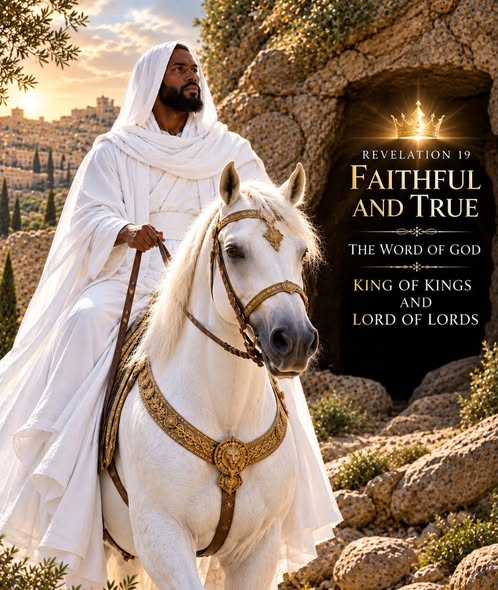
Yahshua stood behind me, almost like he was overshadowing me, and as I stepped out of the cave, I confirmed a private code he had given me earlier. Once it was verified, I knew in the vision that it was safe to go with him. He got down from the white horse, took my hand, and we walked together toward a banquet table. I sat down while Yahshua went to prepare my meal, and the atmosphere felt like we were part of a sacred feast. Looking back, the imagery strongly reminds me of biblical themes like the Bride, the wedding feast, preparation, and the return of Christ.

Revelation 19 contains remarkably similar symbols. The chapter first speaks about the Marriage Supper of the Lamb and the Bride preparing herself:

“Let us be glad and rejoice, and give honour to him: for the marriage of the Lamb is come, and his wife hath made herself ready.”
— Revelation 19:7

Then the Bride is associated with fine linen, clean and white (Revelation 19:8), followed by the declaration:

“Blessed are they which are called unto the marriage supper of the Lamb.” — Revelation 19:9

And only a few verses later comes the imagery that has always made this particular vision so memorable to me:

“And I saw heaven opened, and behold a white horse…”
Revelation 19:11

The sequence is beautiful to contemplate: the Bride prepares herself, the marriage supper is announced, heaven opens, and the rider upon the white horse appears.

This is why I have shared this dream so many times throughout the years. For me, it remains one of the most beautiful dreams I have ever experienced. The white horse, white linen, ancient land, cave, private sign of recognition, being taken by the hand, and finally being brought to a prepared table all came together in a way that was unforgettable.

And when I consider that the vision occurred March 21, immediately after the spring equinox, another symbolic pattern emerges. The equinox marked the threshold; then came the beginning of spring—a season traditionally associated with renewal, increasing light, awakening, resurrection, and new life. The timing of the spring equinox has become meaningful to me as I reflect upon the symbolism years later. There was also something much more personal behind my waiting in the cave.

Before this experience, I had another extraordinary dream in which I met with Yahshua aboard what appeared to me as a heavenly vessel or chariot. There was a gathering aboard the vessel, and I had been called there. I was shown different things while aboard, and I remember that I did not want to leave. Yet I eventually had to return. Before departing, Yahshua told me that he would come back to get me tomorrow. At that time, I was really thinking I had 24 hours until his return but of course that wasn’t the case lol. But I was waiting for him and then I realized the 24-hour notice meant his return was soon. After that dream, I remembered his words. I watched, I waited, and some time passed.

Then, unexpectedly, Yahshua appeared again in this March 21, 2018, vision—this time riding upon a white horse. And I was already waiting for him at the cave. When I reflect upon that part of the vision, I cannot help but think about the parable of the wise virgins in Matthew 25. The wise virgins kept their lamps prepared because they did not know precisely when the bridegroom would arrive. Then suddenly the announcement came:

“Behold, the bridegroom cometh; go ye out to meet him.”
Matthew 25:6

That imagery resonates deeply with how I experienced the dream. I had been told previously that Yahshua would return for me. I did not know when. Yet when he unexpectedly appeared, I was already there waiting. And then he took me by the hand and led me toward the feast. For me, the message I carry from these experiences is ultimately one of preparation. Keep watch, keep your lamp burning, keep your heart prepared and always walk in love, truth, humility, and faithfulness to the Creator. The Bride prepares herself by becoming spiritually ready for the Bridegroom. She is ultimately preparing herself for ascension.

After winter comes spring; after darkness comes increasing light; after waiting comes the appointed season; and after preparation comes the feast. “Blessed are they which are called unto the marriage supper of the Lamb.” — Revelation 19:9 – Seraphim Sophia (Latisha W.)

The First Book of Adam and Eve: The Fall, the 5,500-Year Covenant, and the Promise of Redemption

Greeting my dear brothers and sisters I wanted to share a summary of the First Book of Adam and Eve. Here is a free pdf so that you can read the entire book for yourself. The First Book of Adam and Eve. Early in my journey, I read many books about the plan of salvation for Adam and his descendants. These texts mean a lot to me because they mirror my own path to Christ. After realizing I had sinned, I repented and returned to the covenant, learning so much along the way. I often pray for the gates of Paradise to open again so I can return to that original state I once knew in a higher realm. Reading these works opens my mind to the reality of our original consciousness before entering the physical world. We’ve had to learn so much and strive to stay close to God’s kingdom, avoiding deception from Satan in this life. In today’s world, there’s a lot of deception, and many people have been misled. Many of us have prayed for deliverance and restoration, and it’s deeply meaningful that the Creator sent His Son Yahshua on a divine mission to redeem, restore, and deliver Adam and his righteous descendants. Yahshua has already come to deliver Adam and his righteous descendants. Believers in Christ understand now that the gates of Paradise are open to us if we choose to follow the light of the One Creator and live by His commandments, which are summed up in Love. I hope we all continue to strive to live in holiness and righteousness so that we, too, may ascend to Paradise. Many believe in the second coming of Christ at the end of this age. I picture Yahshua descending from Paradise, with all the saints who have ascended returning alongside him, just as the scriptures say. It would be a descent from Paradise, perhaps through a portal opening in the sky, revealing the heavenly city of New Jerusalem before our eyes. But I will continue to reflect on the scenery of the return of Christ but I want to share information from the First Book of Adam and Eve.

The First Book of Adam and Eve presents an expanded account of Adam and Eve’s life after their departure from the Garden of Eden. Throughout the story, they grieve over the loss of Paradise, their former bright nature, and the heavenly perception they possessed before the Fall. Yet their exile is accompanied by a promise: after an appointed period represented by five and a half days, or 5,500 years within the book’s chronology, the Word will come to save Adam and his righteous descendants. From that point forward, Adam’s earthly life becomes a journey of repentance, prayer, fasting, spiritual conflict, discernment, and learning to live in a mortal body. Running beneath the entire narrative is the expectation that humanity’s fallen condition will eventually be answered by God’s promised restoration.

Chapter 1 — The Cave of Treasures

After Adam and Eve leave Paradise, they enter an unfamiliar world that bears little resemblance to the glorious environment they once knew. God appoints the Cave of Treasures as their earthly dwelling, but Adam initially experiences the cave as dark, restrictive, and sorrowful compared with Eden. Their new surroundings immediately demonstrate how dramatically their condition has changed. Nevertheless, God does not abandon them after their transgression but provides a place where they can live while His purposes concerning them unfold. The Cave of Treasures gradually becomes a sacred place associated with prayer, divine promises, offerings, and the treasures that will later point toward future redemption.

Chapter 2 — From the Bright Nature Into the Earthly Condition

Adam and Eve are overwhelmed by the strange appearance of the earth outside Paradise. The rocks, sand, and physical landscape frighten them because they have never experienced creation from their present condition. Their distress becomes so severe that they collapse as though dead, but God sends His Word to raise them. The chapter begins developing the contrast between Adam’s former bright nature and his present earthly existence. From this point onward, Adam will continually measure his mortal condition against the glorious state he remembers possessing in Paradise.

Chapter 3 — The Promise of the 5,500 Years

God gives Adam one of the central promises of the entire book when He speaks of the “great five and a half days.” Adam initially understands this as only five ordinary days and half of another, but God explains that each prophetic day represents a thousand years, making the appointed period 5,500 years. At the fulfillment of that time, the Word who created Adam will come for his salvation. The promise extends beyond Adam personally to his descendants, establishing restoration as part of the future history of humanity. The 5,500-year covenant consequently becomes the great prophetic thread running throughout the remainder of the story.

Chapter 4 — Adam Mourns His Lost Heavenly Sight

Inside the Cave of Treasures, Adam compares its darkness and narrowness with the beauty and spaciousness of Paradise. He especially mourns the loss of his former ability to perceive heavenly beings and realities. Before the Fall, Adam remembers seeing angels and participating in an existence surrounded by divine light, but his present fleshly condition limits that perception. His grief reveals that the Fall involves much more than removal from a geographical garden. According to the framework of the book, humanity has undergone a profound change of condition involving spiritual perception, bodily existence, and access to the heavenly realm.

Chapter 5 — Eve’s Repentance and Intercession

When Adam collapses from grief, Eve believes he has died and cries out to God for mercy. She acknowledges her involvement in their transgression and recognizes the enormous contrast between the light they possessed before and the darkness surrounding them now. Eve asks God to restore Adam so he can continue seeking forgiveness and repentance. She does not want to continue without him because she remembers that she was taken from his side and that their lives are joined together. This chapter presents Eve not only in connection with the Fall but also as a grieving and repentant woman interceding for her husband.

Chapter 6 — Why the Bright Nature Was Lost

God raises Adam and Eve and explains further what their disobedience has produced. They once possessed a bright nature, but after choosing to transgress God’s command they entered the diminished condition they now experience. God connects their temptation with Satan’s own rebellion and desire for exaltation. The deception promised Adam and Eve something greater, but instead it resulted in the loss of the glory they already possessed. Yet even while explaining the consequences of their choice, God continues preserving them rather than abandoning His creation.

Chapter 7 — God Will Not Break His Covenant

Adam and Eve begin to understand that although they remain outside Paradise, God’s relationship with them has not ended. God reassures Adam that He has made a covenant and will not turn away from it. The restoration Adam desires cannot happen immediately because the appointed five and a half days must first reach their fulfillment. God also places limits upon the animals so they will not simply destroy Adam, Eve, or the righteous descendants who will come from them. The chapter therefore establishes an important distinction between living under the consequences of the Fall and being completely abandoned by God.

Chapter 8 — The Loss of Spiritual Perception

Adam asks why he can no longer see the heavenly world as he once did. God explains that while Adam remained obedient, his bright nature enabled him to perceive realities that his present condition no longer allows him to see in the same way. After the transgression, his perception became restricted according to the flesh. This loss becomes one of Adam’s deepest sources of sorrow because he remembers what direct awareness of the heavenly realm was like. The book therefore describes humanity’s fallen condition as involving a veil between ordinary earthly perception and the higher spiritual realities Adam once experienced openly.

Chapter 9 — The Tree and Water of Life

Adam and Eve encounter waters associated with the region of the Tree of Life, awakening powerful memories of Paradise. What once belonged naturally to their environment has now become inaccessible to them because of their changed condition. Their grief becomes so overwhelming that they fall into the water and nearly die. The Tree and Water of Life begin to emerge as important symbols of everything Adam has lost through the Fall. As the story develops, both will become connected with God’s promise that life will eventually be restored.

Chapter 10 — The Mortal Body

God rescues Adam and Eve and explains that their present bodies now require water and earthly nourishment. These physical needs contrast sharply with the condition Adam remembers possessing in Paradise. Adam again longs to return to the Garden, but God directs him toward the future rather than granting immediate restoration. The promise now includes Adam’s righteous descendants, who will eventually share in what God intends to accomplish. Adam begins learning that his personal salvation is connected with a much larger story involving generations yet unborn.

Chapter 11 — Remembering the Light of Eden

Adam continues remembering the extraordinary brightness of his former existence. Paradise was characterized by light, life, heavenly presence, and an intimacy with creation that he can no longer experience in the same way. The darkness of the Cave of Treasures makes those memories even more painful. Yet remembrance also prevents Adam from becoming satisfied with his fallen condition because he knows something greater once existed. His life now stretches between the Paradise he remembers and the restoration God has promised.

Chapter 12 — The First Night

When darkness falls upon the earth, Adam and Eve initially do not understand what is happening. Adam fears that the light has permanently disappeared and that their condition has become even worse. The darkness is so complete that he cannot see Eve beside him, intensifying his fear and grief. God sends His Word to comfort them and teaches them that earthly darkness has an appointed period. Adam is slowly learning that not every frightening experience outside Paradise represents another divine punishment.

Chapter 13 — Children of Light

God explains the cycle of darkness and returning daylight so Adam will understand that night itself is not permanent abandonment. The discussion also returns to the difference between Adam’s former brightness and Satan’s loss of heavenly glory. The text describes Adam as having been created in connection with light and speaks of children of light coming from him. The idea of righteous descendants therefore begins appearing alongside the promise of future restoration. Humanity’s story will not consist only of corruption; a line of people seeking God will continue through Adam.

Chapter 14 — The Future Coming of the Word

God again directs Adam’s attention toward the future coming of the Word. Adam cannot simply undo the Fall by grieving intensely enough or finding a hidden entrance back into Paradise. The One responsible for his creation will ultimately have to intervene in his fallen condition. This makes the covenant increasingly redemptive rather than merely chronological. Adam’s hope rests not in his ability to reverse what happened but in God’s promise to act at the appointed time.

Chapter 15 — The Return of Daylight

Adam eventually witnesses the sunrise and discovers that the darkness he feared was temporary. The returning light brings comfort because it teaches him something about earthly existence that he did not previously understand. His first night outside Eden becomes a lesson about fear, perception, and trust. Adam had interpreted darkness as though light had been permanently removed, yet morning proves otherwise. The experience begins teaching him that what appears final from within his limited earthly perspective may not actually be final.

Chapter 16 — Adam and Eve Begin Their Fast

Adam and Eve decide to undertake an intense period of fasting and prayer as an expression of repentance. Adam enters the Jordan while Eve enters another river, and both seek God’s mercy concerning their transgression. They hope that through humility and repentance they might find restoration and forgiveness. Their actions show that they refuse to become spiritually indifferent to what happened in Eden. Fasting now becomes one of the repeated practices through which Adam and Eve express sorrow, discipline, and their desire to return toward God.

Chapter 17 — Creation Joins Adam’s Prayer

While standing in the water, Adam calls upon the creatures around him to participate in praising the Creator. The scene presents creation as a witness to humanity’s repentance and longing for reconciliation. Adam, who once exercised dominion from within Paradise, now stands humbly among earthly creatures seeking mercy. Although his relationship with creation has changed, he still understands creation as belonging to God and capable of joining in praise. His spiritual response to the Fall therefore includes bringing his sorrow before the Creator rather than turning completely away from Him.

Chapter 18 — Satan Appears as an Angel of Light

Satan approaches Eve during her fast but does not appear in an obviously threatening form. Instead, he disguises himself as an angel of light and announces that God has supposedly accepted their repentance. Eve believes the message and leaves the water before completing the appointed period. The incident introduces one of the strongest themes in the entire book: spiritual deception can imitate heavenly appearance and religious language. Adam and Eve must therefore learn that supernatural appearance alone does not prove that a message comes from God.

Chapter 19 — Adam Recognizes Satan’s Deception

When Eve reaches Adam, he realizes that Satan has deceived her and interrupted her fast. Adam confronts Satan and asks why he continues persecuting them after they have already lost Paradise and their former glory. The question exposes Adam’s growing awareness that something larger lies behind Satan’s hostility toward humanity. Satan’s answer will connect Adam’s suffering with events that occurred before the human Fall. The spiritual conflict surrounding Adam is therefore rooted in an older rebellion.

Chapter 20 — Satan Explains His Rebellion

Satan tells Adam that his hostility began when Adam was created in God’s image and the heavenly beings were commanded to honor God’s work in him. Satan refused because he considered himself greater and would not humble himself before Adam. His pride resulted in the loss of his heavenly position, and seeing Adam placed in Paradise intensified his envy. Satan therefore sought to make Adam lose the glory and dwelling that Satan himself had lost. Within the framework of the book, the temptation in Eden is consequently presented as part of a conflict driven by pride, jealousy, and resentment.

Chapter 21 — Adam Turns to God for Protection

After hearing Satan’s explanation, Adam recognizes that he cannot navigate this spiritual conflict by relying solely upon himself. He turns toward God for protection and guidance. Adam now understands that the being opposing him possesses knowledge of heavenly things and is capable of deception. His response is increasingly to seek the Creator rather than attempt to defeat the adversary through his own power. Dependence upon God becomes essential to surviving both the physical and spiritual dangers of life outside Paradise.

Chapter 22 — Adam Continues His Repentance

Adam remains committed to repentance even after Satan’s interference. The hardships surrounding him do not eliminate his desire to seek reconciliation with God. He continues praying and humbling himself while learning that repentance does not instantly erase every consequence of the Fall. The bright nature is not immediately restored, and Paradise remains closed. Adam must therefore learn how to remain faithful even when the restoration he desires has not yet appeared.

Chapter 23 — Eve Shares Adam’s Sorrow

Eve continues sharing Adam’s grief and repentance as they struggle to understand their new earthly condition. Their suffering is not merely individual because the consequences of their transgression affect them together. Eve repeatedly participates in prayer, fasting, and their search for God’s mercy. The relationship between Adam and Eve therefore becomes one of mutual suffering as well as companionship. Together they must learn how to live outside the Garden while remembering the promise that their exile will not continue forever.

Chapter 24 — Satan Continues His War Against Adam

Satan refuses to leave Adam and Eve in peace and repeatedly looks for ways to weaken their trust in God. His attacks alternate between physical danger, fear, false appearances, and spiritual deception. The book portrays this conflict as persistent because Satan understands that Adam remains connected with a future divine promise. Adam consequently begins discovering that spiritual warfare does not always appear in the same form. Discernment requires recognizing the adversary even when his method changes.

Chapter 25 — God Preserves Adam and Eve

Despite Satan’s repeated efforts, Adam and Eve continue being preserved. God intervenes when their lives are threatened and prevents Satan from completely destroying them. These rescues gradually teach Adam that divine protection remains active even though he has not yet been restored to Paradise. The covenant therefore functions not only as a distant future promise but also as a reason Adam’s life continues in the present. God preserves the human family through which the future promise will unfold.

Chapter 26 — Adam Learns to Wait

Adam repeatedly wants immediate restoration, but God continues teaching him that the appointed time cannot simply be bypassed. His repentance is real, yet the covenant has its own fulfillment. Waiting becomes one of Adam’s most difficult spiritual disciplines because he remembers exactly what he has lost. The story therefore distinguishes between forgiveness, preservation, and complete restoration. Adam may receive mercy now while still waiting for the larger promise concerning the future.

Chapter 27 — The Cave Becomes a Sacred Place

The Cave of Treasures gradually takes on a different meaning for Adam and Eve. What initially appeared only as a dark prison outside Paradise becomes a place where they encounter God, pray, and preserve sacred memories. Their earthly dwelling cannot replace Eden, but it becomes a place where they can continue seeking the Creator. This transformation shows Adam learning to recognize God’s presence even outside the environment he considers ideal. The cave becomes connected with the covenant rather than merely with exile.

Chapter 28 — Adam’s Dependence Upon God’s Word

Throughout these experiences Adam repeatedly collapses physically or emotionally, and God’s Word raises and strengthens him. The repeated pattern emphasizes Adam’s weakness in his present condition. He cannot sustain himself through memory of his former glory alone. Each intervention reinforces the connection between the Word who created Adam and the Word who will eventually accomplish his promised salvation. The book is steadily preparing the reader for the future redemptive role assigned to the Word.

Chapter 29 — Satan Cannot Cancel the Promise

Satan’s attacks become increasingly severe, yet none succeeds in destroying the covenant God has established. Adam may be deceived, wounded, frightened, or weakened, but God repeatedly restores him. The narrative therefore places limits around Satan’s power: he can oppose Adam, but he cannot independently overturn God’s promise. Adam gradually learns this through experience rather than through a single revelation. His survival becomes continuing evidence that the covenant remains active.

Chapter 30 — Preparing for the Treasures

As Adam and Eve continue seeking God, the Cave of Treasures becomes the setting for signs that will point beyond their present suffering. Their earthly life is still difficult, but God begins providing tangible reminders of what He has promised for the future. These treasures will not themselves restore Adam, but they will help preserve the memory of the covenant. The narrative is therefore transitioning from general promises toward increasingly specific prophetic signs. Those signs become explicit in the following chapter through gold, incense, and myrrh.

Chapter 31 — Gold, Incense, and Myrrh

God explains the meaning of the treasures given to Adam: gold, incense, and myrrh. Within the book, gold points toward the future kingdom, incense toward divinity, and myrrh toward suffering and death associated with God’s coming in the flesh. Their arrival around the third day after Adam’s expulsion is also given prophetic meaning connected with the future three days associated with the Lord in the earth. The treasures therefore become more than objects of comfort for Adam. They are signs preserved inside the Cave of Treasures that point toward the future fulfillment of his salvation.

Chapter 32 — Adam and Eve Return to Fasting

Adam and Eve undertake another period of fasting and prayer because their desire for restoration remains intense. They continue hoping that God will forgive their transgression and return them to their former condition. Their willingness to repeat these practices demonstrates persistence, but it also shows that they have not yet fully understood the timetable of the covenant. Adam and Eve still hope their suffering might accelerate their restoration. Their fast becomes the setting for another test of spiritual discernment.

Chapter 33 — Another Counterfeit Angel

Satan again approaches Eve in angelic form and claims that God has accepted their repentance. He strengthens the deception by describing genuine details concerning the treasures and previous heavenly events. Because the information is accurate, Eve assumes the messenger must be genuine and follows him. Adam later recognizes what has happened and grieves over the interrupted vow. The chapter warns within its own narrative that accurate spiritual information can still be used deceptively when it is joined with a false message.

Chapter 34 — Adam Remembers His Original Creation

Adam recounts his creation and the condition he possessed before the Fall. He remembers knowledge, authority over the animals, spiritual perception, and the bright nature that distinguished his existence in Paradise. He contrasts this with hunger, thirst, weakness, exhaustion, sorrow, and other experiences of mortal life. His prayer provides one of the clearest descriptions in the book of what humanity supposedly lost through transgression. Adam’s hope for salvation is therefore inseparable from his longing for restoration of the original human condition.

Chapter 35 — God Explains the Present Condition

God reminds Adam that his present suffering belongs to the earthly condition he entered after leaving Paradise. Hunger, thirst, bodily weakness, and the need for sleep were not experienced in the same way during his former existence. Adam is now living in what the text repeatedly describes as a strange land. The chapter reinforces that exile involves both location and embodiment. Adam must learn how to exist in this new condition until the covenant reaches fulfillment.

Chapter 36 — The Figs From Paradise

God commands a cherub to bring Adam and Eve figs from the Garden. The heavenly being cannot approach them normally because their flesh cannot endure the cherub’s fire, so the figs are delivered from a distance. The narrator emphasizes a dramatic reversal: heavenly beings once trembled before Adam, but Adam now trembles before them. Even God’s provision of food reminds Adam of the difference between his former and present nature. The figs therefore become both nourishment and a painful reminder of Paradise.

Chapter 37 — Adam Asks for the Tree of Life

Adam hesitates to eat the figs and instead asks God for fruit from the Tree of Life. He reasons that he and Eve have spent many days fasting and repenting for the transgression they committed in a short period. Adam hopes that their prolonged suffering might compensate for what happened and allow them to recover eternal life. His request reveals that he is still trying to understand whether restoration can be obtained through his own penitential effort. God’s answer establishes that the Tree of Life will be restored only according to the covenant.

Chapter 38 — The 5,500 Years and Eternal Life

God tells Adam that he cannot receive the Tree of Life at the present time. When the 5,500 years are fulfilled, however, Adam will receive its fruit together with Eve and their righteous descendants. They will then live forever according to the promise given in the book. Adam is instructed to endure until the covenant reaches its appointed fulfillment. The 5,500-year prophecy is therefore explicitly connected with the recovery of the eternal life lost through the Fall.

Chapter 39 — Adam Becomes Afraid to Eat

Adam becomes frightened by the idea of eating because his original transgression involved forbidden fruit. Even food that God has permitted now awakens anxiety within him. His fear demonstrates that the Fall has affected his consciousness as well as his body and environment. Adam asks God whether he can somehow survive without eating the figs. The experience teaches him that obedience, rather than eating itself, was the true issue surrounding the original command.

Chapter 40 — The Needs of the Earthly Body

God explains that Adam’s present body requires earthly food in order to survive. His former bright condition did not depend upon nourishment in the same manner, but his mortal body now belongs to an earthly order. Adam must therefore accept food as part of living responsibly in his changed condition. The lesson is another step in his adaptation to life outside Eden. He cannot live as though his body still possesses the qualities it had before the Fall.

Chapter 41 — Adam Seeks the Water of Life

Adam next asks for the Water of Life, hoping that it might restore him and free him from mortality. He travels toward the waters flowing from the Garden and remembers that thirst did not trouble him during his former existence. Adam even asks God to place him somewhere else if he cannot return to Paradise. His longing reveals that he still associates salvation with recovering the life-giving realities he once possessed. God’s answer transforms that longing into a prophecy of a much greater future deliverance.

Chapter 42 — The Descent Into Hell and the Water of Life

God tells Adam that true rest ultimately belongs to the Kingdom of Heaven rather than another earthly country. The text then declares that God will one day descend into Hell, break its gates, and save Adam’s soul together with the souls of the righteous. The Water of Life Adam seeks is also connected with the blood God says He will shed at Golgotha when He comes to Earth. The promise of the 5,500 years has therefore become a detailed prophecy involving death, descent, liberation, and restoration. Adam learns that his ultimate deliverance will come not through escaping earthly difficulty but through God’s future victory over the condition holding the dead.

Chapter 43 — Fire Surrounds the Cave

Satan gathers combustible materials and surrounds the Cave of Treasures with fire. Adam initially assumes that God has caused the disaster and fears that he is being driven even farther from Paradise. Satan’s deeper purpose is to make Adam believe that God has abandoned him so that he will lose faith in the covenant. God protects the cave and prevents the fire from accomplishing Satan’s intention. Adam again must learn not to attribute every frightening event to God.

Chapter 44 — Adam Realizes That He Has Changed

As Adam observes the fire, he reflects upon the difference between his former relationship with creation and his present vulnerability. Fire itself has not fundamentally changed; Adam’s condition has changed. The body he now possesses can be burned and injured in ways his former bright nature did not experience. This realization deepens his understanding of what the Fall has done. The physical world continually mirrors back to Adam the limitations of his mortal condition.

Chapter 45 — The Fire Becomes a Sign of Hell

God uses the fire surrounding the cave as a teaching sign concerning Adam’s future. Just as Adam cannot create his own path through the flames, he will not be able to deliver himself from the condition awaiting him after death. His future escape will depend upon the coming of God’s Word and fulfillment of the covenant. God then divides the fire so Adam can safely pass through it. The physical rescue becomes a prophetic demonstration that God will one day open a way where Adam cannot open one himself.

Chapter 46 — Satan Attacks the Opened Way

Even after God opens a path through the fire, Satan attempts to injure Adam and Eve by causing the flames to surge toward them. Their bodies are burned until God intervenes and sends help. God then reminds Adam and Eve of the contrast between Satan’s promises and Satan’s actual behavior toward them. The being who claimed to offer exaltation continually attempts to destroy them, while God repeatedly preserves them. Their suffering becomes another lesson in judging spiritual claims by what they actually produce.

Chapter 47 — Satan Understands the Covenant

The narrative reveals that Satan understands the significance of God’s promise to Adam. He knows Adam has been promised future salvation and that righteous descendants will inherit what Satan lost. Satan therefore reasons that killing Adam before he produces children might prevent the promised descendants from appearing. His opposition to Adam becomes explicitly connected with opposition to the covenant. The survival of Adam and Eve is consequently necessary for the future human family described in God’s promise.

Chapter 48 — The Great Rock

Satan and his hosts attempt to crush Adam and Eve beneath an enormous rock while they sleep. Instead of allowing the rock to destroy them, God transforms it into a protective covering while lowering the ground beneath them. Adam awakens frightened and initially wonders whether God has imprisoned him because of another transgression. Once again Satan’s attempted destruction becomes something God turns toward preservation. The rock then becomes the basis for one of the book’s most explicit prophetic signs.

Chapter 49 — The Tomb and Resurrection

God tells Adam that his experience beneath the rock foreshadows what will happen when God comes upon Earth. He will be put to death, placed within a rock or tomb, and sealed behind a great stone. The text says He will remain there for three days and three nights and then rise on the third day. God directly connects this future resurrection with salvation for Adam and those descendants who believe. Adam’s own confinement beneath the rock therefore becomes a prophetic sign of burial, resurrection, and the fulfillment of the covenant.

Chapter 50 — The Need for Earthly Clothing

Adam and Eve recognize that their present bodies require garments. Their former bright nature had provided a condition of glory that no longer surrounds them. God directs them toward sheepskins that can be used as clothing. The need for physical garments becomes another visible sign of their mortality and changed bodily condition. Adam is learning that earthly life requires practical provisions that were unnecessary in Paradise.

Chapter 51 — Satan Is Exposed

Satan attempts to interfere with Adam and Eve obtaining the sheepskins, but God restrains him. Adam and Eve are allowed to see the adversary in his fallen condition rather than the beautiful forms he repeatedly assumes. God reminds them that this is the being who promised them glory and divinity while actually contributing to their loss of the garment of light. The contrast between appearance and reality becomes unmistakable. Satan can imitate beauty, but God exposes the condition hidden beneath the disguise.

Chapter 52 — The Garments of Skin

An angel teaches Adam how to prepare the sheepskins and turn them into garments. Adam recognizes that these skins once belonged to living animals that have now died, making the clothing a reminder of mortality. The garments stand in sharp contrast with the bright nature Adam and Eve possessed before the Fall. Nevertheless, God provides what they need within their present condition rather than leaving them naked and helpless. Divine care continues even though complete restoration remains future.

Chapter 53 — The Western Lands and the Flood

Adam and Eve wander westward, where Satan again attempts to frighten them through deceptive appearances. God instructs Adam to return toward the place appointed for him and reveals something about the future of his descendants. Humanity will multiply, but corruption will eventually spread among them and a great flood will come. A righteous remnant, however, will be preserved. The history of Adam’s descendants is therefore already presented as containing both corruption and divine preservation.

Chapter 54 — Adam Approaches Paradise Again

Adam and Eve eventually approach the border of Paradise once more. The cherub guarding the Garden prepares to prevent their entrance, but the scene causes uncertainty among the heavenly beings because they wonder whether Adam’s restoration has finally arrived. Adam and Eve collapse from fear and longing as the angels observe them. The moment dramatizes the great question running through the entire narrative: when will Adam return? God’s answer again directs everyone toward the covenant.

Chapter 55 — Only When the Covenant Is Fulfilled

God tells Adam plainly that his return to Paradise cannot happen yet. He may enter only when the covenant made concerning him reaches fulfillment. Adam hears the angels around him but cannot see them, causing him to grieve once more over the loss of his bright nature. The angels themselves intercede for Adam and ask God to preserve him until the promise is completed. Both heaven and earth therefore appear within the story as waiting for the appointed restoration.

Chapter 56 — Adam Is Comforted

God continues comforting Adam while reminding him that his present condition differs from Paradise. Adam must live within earthly limitations even though he remembers something greater. His hope cannot depend upon immediately recovering everything he lost. Instead, he must learn endurance while trusting that God has not forgotten the covenant. Waiting becomes an essential part of Adam’s spiritual development.

Chapter 57 — Prayer Outside Paradise

Adam and Eve continue establishing patterns of prayer outside the Garden. Paradise remains inaccessible, yet communion with God has not completely disappeared. The Cave of Treasures and places of offering become locations where they repeatedly turn toward the Creator. Adam begins discovering that exile does not prevent worship. He can seek God even while awaiting the larger restoration he cannot yet possess.

Chapter 58 — Offerings and Remembrance

Adam increasingly uses offerings as expressions of gratitude, repentance, and dependence upon God. These practices help organize his spiritual life outside Eden. The offerings cannot themselves reopen Paradise, but they become signs of Adam’s continuing relationship with the Creator. His worship is therefore oriented toward both remembrance and hope. Adam remembers what was lost while trusting what God has promised for the future.

Chapter 59 — Learning Earthly Obedience

Adam’s experiences continue teaching him that faithfulness outside Paradise requires practical obedience. He must not simply long for the past but learn how God wants him to live in the present. This includes prayer, work, restraint, and dependence upon divine instruction. His earthly life gradually becomes a school of spiritual formation. The man who failed a command in Eden is learning to wait for God’s direction before acting.

Chapter 60 — God’s Provision Continues

God continues providing for Adam and Eve even though their environment remains difficult. Their survival depends upon learning how to receive and use what the earth provides. Each act of provision demonstrates that the Creator has not abandoned them simply because they are outside the Garden. At the same time, provision is not the same as full restoration. Adam receives what he needs for mortal life while continuing to await eternal life.

Chapter 61 — Adam Faces the Reality of Labor

Earthly survival increasingly requires Adam to work. This is a major contrast with the abundance he remembers in Paradise. His mortal body becomes tired, hungry, and dependent upon the results of physical labor. Yet labor also becomes part of Adam’s education concerning earthly life. He must learn how to participate actively in sustaining the life God continues preserving.

Chapter 62 — The Earth Must Now Be Worked

Adam recognizes that food will not simply appear in the same manner as the abundance he experienced in Eden. The earth must be approached through work, knowledge, and patience. His relationship with the ground therefore reflects his changed condition after the Fall. The same earth from which Adam was formed now becomes the source from which his mortal body must obtain nourishment. Humanity’s earthly vocation begins developing alongside its spiritual longing for restoration.

Chapter 63 — God Teaches Adam

Rather than leaving Adam completely without knowledge, God continues instructing him in the skills necessary for earthly survival. Adam must learn things he never needed to know while living in Paradise. This divine instruction shows that God’s relationship with humanity includes practical guidance as well as spiritual promises. Adam’s education now concerns both heaven and earth. He is being taught how to survive below while continuing to hope for what is above.

Chapter 64 — Grain and the Promise of Bread

Adam discovers grain and begins learning that it can become nourishment for his body. The process requires knowledge, effort, and patience. What appears ordinary to later humanity is entirely new within Adam’s experience. God gives him understanding concerning how the grain should be handled. Bread thus enters the story as part of God’s provision for mortal life and will soon acquire a deeper prophetic meaning.

Chapter 65 — Adam Learns to Make Bread

Adam works with the grain until it can be prepared as bread. The labor exhausts him, demonstrating again the limitations of his present body. Yet he also experiences joy because he has learned something necessary for survival. The chapter portrays knowledge of earthly crafts as part of humanity’s adaptation after Eden. Adam is becoming not merely the first exile from Paradise but also the first learner of the practices through which earthly civilization will continue.

Chapter 66 — Provision in the Strange Land

The availability of grain and other food teaches Adam that the earth outside Paradise, though difficult, is not entirely without provision. God continues sustaining Adam within the strange land even while withholding immediate access to the Tree of Life. This distinction becomes important throughout the book. Earthly food preserves mortal existence, while the Tree and Water of Life symbolize the greater restoration still to come. Adam must receive one while waiting for the other.

Chapter 67 — Satan Burns the Wheat

After Adam gathers wheat, Satan burns it and empties the available water. Satan then appears with his hosts as angels praising God and claims that God has sent them to lead Adam toward better provision. Adam believes the deception and follows them for days until he and Eve collapse from hunger and exhaustion. The episode is one of the clearest warnings in the book concerning counterfeit spiritual guidance. Satan imitates worship, angelic appearance, and divine authority while actually leading Adam away from what God provided.

Chapter 68 — God Reveals the Deception

God raises Adam and explains that He did not burn the wheat, empty the water, or send the apparent angels. Satan was responsible for the destruction and deception. God restores the provision and sends genuine heavenly assistance, teaching Adam again to distinguish divine action from counterfeit spiritual claims. Adam then offers grain to God, and the offering receives heavenly blessing. The book connects this offering with God’s future flesh, allowing bread to become another sign pointing toward the promised redemption.

Chapter 69 — Blood and Water From Adam’s Side

While Adam makes an offering, Satan pierces him in the right side and blood and water flow from the wound. Adam collapses upon the altar, but God’s Word raises and heals him. God explicitly tells Adam that this event points toward what will happen when He comes upon Earth and is Himself pierced. Blood and water will flow from His side, and His body will become the true offering. Adam’s own suffering therefore becomes another prophetic sign of the future work through which the covenant will be fulfilled.

Chapter 70 — Satan Counterfeits the Three Angels

Satan and two companions take forms resembling the three genuine angels associated with the gold, incense, and myrrh. They approach Adam with a supposed message from God concerning marriage and pressure him into promising obedience before hearing the full instruction. Their strategy depends upon Adam recognizing a familiar heavenly pattern and assuming the imitation must be genuine. Satan is therefore counterfeiting not merely angelic appearance but a previous authentic experience. Adam’s growing discernment will determine whether the deception succeeds.

Chapter 71 — Adam Tests the Message

After hearing the supposed command, Adam becomes suspicious because God Himself has not spoken to him concerning the matter. He realizes that the apparent angels are deceptive beings and refuses to obey them. Adam is troubled because he invoked God’s name during the encounter, so he returns to fasting and prayer. God forgives and warns him again concerning Satan. This chapter marks significant spiritual growth because Adam is finally learning to test a message rather than trusting appearance alone.

Chapter 72 — Satan Appears as Beautiful Human Beings

Satan tries another method by appearing with his hosts as beautiful men and women who seem to have families of their own. They encourage Adam to join with Eve and produce children as they supposedly have done. Adam experiences bodily desire but refuses to allow desire or external example to become his authority. Instead, he returns to God and asks directly what he should do. The chapter reinforces Adam’s developing principle of waiting for divine instruction rather than allowing appearances, impulses, or spiritual beings to determine his actions.

Chapter 73 — God Establishes Adam and Eve’s Marriage

God responds to Adam’s prayer by sending genuine heavenly messengers with instructions concerning his union with Eve. Adam now receives from God what Satan had previously attempted to make him do without divine authorization. Adam and Eve pray and fast before entering their marriage, and their union is described as pure and directed toward producing descendants. The chapter therefore distinguishes the act itself from the question of obedience surrounding it. Adam’s victory lies in waiting until he receives genuine direction rather than repeating the impulsive disobedience associated with Eden.

Chapter 74 — Cain and Luluwa Are Born

Eve eventually becomes pregnant and experiences the suffering associated with childbirth in the mortal condition. She gives birth to twins, Cain and Luluwa, beginning the first generation born outside Paradise. Adam and Eve respond by turning toward God and making offerings concerning their children. The descendants previously spoken about only in prophecy now actually appear within the story. The covenant is beginning to move through generations rather than remaining solely a promise made to Adam.

Chapter 75 — Abel and Aklia Are Born

Eve later gives birth to another pair, Abel and Aklia. Adam continues the practice of making offerings and bringing his children into connection with the Cave of Treasures and the sacred signs preserved there. The first human family is now established outside Paradise. Adam and Eve must not only navigate their own relationship with God but also teach the next generation about what happened and what has been promised. The question of righteous descendants now becomes central to the narrative.

Chapter 76 — Abel Chooses Prayer

Cain and Abel develop very different spiritual dispositions. Abel is portrayed as meek, obedient, devoted to fasting, prayer, and offerings, while Cain increasingly displays hardness of heart. Adam teaches Abel about Paradise, the Fall, and the treasures connected with God’s promise. When Satan threatens Abel, Abel refuses to believe him and turns toward God instead. The righteous descendant is therefore shown learning the discernment that Adam himself struggled so long to acquire.

Chapter 77 — Cain and Abel’s Offerings

Adam encourages both sons to make offerings to God. Abel approaches worship sincerely, and the book emphasizes that God is pleased not merely with the gift but with Abel’s good heart. Cain’s offering is rejected because his heart is already occupied with jealousy and murderous thoughts. God nevertheless gives Cain an opportunity to change and become righteous. The chapter therefore presents the outward offering as inseparable from the inward condition of the person presenting it.

Chapter 78 — Cain’s Jealousy Deepens

Satan repeatedly feeds Cain’s resentment toward Abel, especially concerning family affection, marriage, and the acceptance of Abel’s offering. Cain begins interpreting Abel’s blessings as though they diminish his own worth and place within the family. Rather than correcting his heart when God gives him the opportunity, he allows jealousy to become anger and anger to become hatred. Satan then encourages him toward violence while Cain increasingly accepts the suggestion. The chapter shows temptation developing gradually from an external suggestion into an internal decision.

Chapter 79 — Cain Murders Abel

Cain deceives Abel by pretending friendship and leading him into an isolated place. Once they are alone, Cain attacks and kills his brother, bringing the first murder into the human family. Abel’s blood cries from the earth, and the ground repeatedly refuses to conceal his body, making his death a witness against Cain. God asks Cain where his brother is, giving him an opportunity to confess, but Cain responds by asking whether he is his brother’s keeper. The book ends with Cain refusing repentance and entering a condition of trembling and lost peace, while the larger promise of Adam’s future restoration remains unfulfilled.

The Great Promise Running Through the Story

From Chapter 1 through Chapter 79, The First Book of Adam and Eve presents human existence after the Fall as a long movement between lost Paradise and promised restoration. Adam remembers a bright nature, spiritual perception, freedom from ordinary bodily suffering, access to the Tree and Water of Life, and direct awareness of the heavenly realm. Outside Paradise he encounters darkness, hunger, thirst, mortality, labor, spiritual deception, bodily weakness, and eventually death within his own family. Yet the story never allows those conditions to erase the covenant God established near the beginning.

The 5,500-year promise becomes the thread holding Adam’s hope together. God repeatedly tells him that the appointed time must be fulfilled before complete restoration occurs. Adam cannot return to Paradise simply because he desires it, nor can prolonged fasting, suffering, or repentance give him immediate access to the Tree of Life. He must endure while trusting that the Word who created him will eventually accomplish what Adam cannot accomplish for himself. The covenant therefore transforms Adam’s life into a period of waiting, learning, repentance, and preparation.

As the chapters progress, the promise becomes increasingly specific. The Word will come in the flesh; suffering and death are foretold; Golgotha and blood are connected with the Water of Life; a pierced side produces blood and water; burial within a rock and resurrection on the third day are foreshadowed; and God promises to descend into Hell, break its gates, and deliver Adam and the righteous. The Tree of Life that Adam cannot presently receive is ultimately promised to him, Eve, and their righteous descendants. Within the framework of this book, redemption therefore means far more than simply returning Adam geographically to the original Garden—it means overcoming the entire condition produced by the Fall.

Adam’s experiences repeatedly become prophetic signs of this future restoration. The gold, incense, and myrrh point toward kingdom, divinity, suffering, and death. The rock points toward the tomb, while Adam’s emergence after three days points toward resurrection. The Water of Life becomes connected with the blood shed at Golgotha, the grain offering becomes associated with the future flesh of the Savior, and the blood and water flowing from Adam’s pierced side foreshadow another future piercing. Adam is therefore not merely told that deliverance will happen; events within his own life continually dramatize aspects of what the promised deliverance will involve.

Another major theme running throughout the book is spiritual discernment. Satan repeatedly appears in forms that seem holy, beautiful, or trustworthy. He appears as an angel of light, imitates genuine angels, praises God, possesses accurate information, and sometimes presents an idea that is not inherently wrong while falsely claiming that God commanded it. Adam initially struggles greatly with these deceptions, but over time he learns an important lesson: a spiritual appearance, supernatural experience, or religious claim should not automatically be treated as God’s Word. By the later chapters, Adam increasingly waits for genuine divine instruction before acting.

The story also demonstrates the difference between falling and refusing to return. Adam and Eve repeatedly make mistakes and experience deception, but they continually return toward God through confession, prayer, fasting, and repentance. Cain follows another path. His jealousy becomes hatred, hatred becomes murder, and when God confronts him he refuses the opportunity to confess. The book consequently ends not with the fulfillment of the 5,500-year promise but with a demonstration of why humanity remains in need of the restoration promised to Adam.

The final picture is therefore one of waiting. Paradise remains beyond Adam’s reach. The bright nature has not yet been restored. Abel has died, Cain has fallen into violence, and mortality continues among Adam’s descendants. Yet God’s covenant remains standing over the entire story. Adam’s hope rests upon the appointed time when the Word will come, confront death, deliver the righteous, and restore the life humanity lost.

Fall → Loss of the Bright Nature → Exile From Paradise → Mortal Condition → Repentance → Spiritual Warfare → Covenant → 5,500 Years → Coming of the Word → Suffering → Golgotha → Blood and Water → Death → Descent Into Hell → Breaking of the Gates → Resurrection → Deliverance of Adam and the Righteous → Tree of Life → Restoration → Everlasting Life.

Take a look at the summary of the Gospel of Nicodemus for the time when the 5500 is fulfilled. The Gospel of Nicodemus: Yahshua’s Trial, Crucifixion, Resurrection, and the Deliverance of the Dead

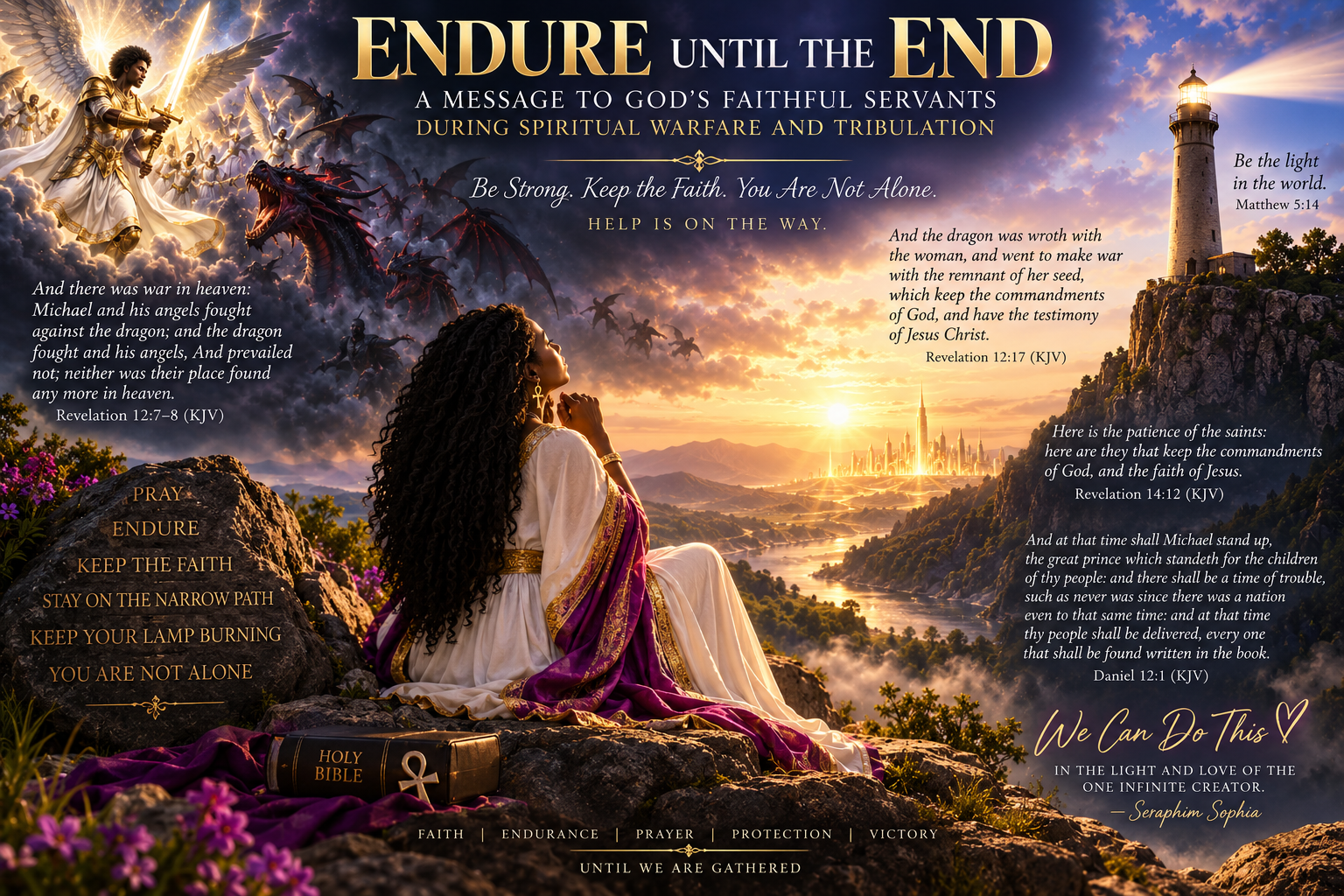
The Gospel of Nicodemus: Yahshua’s Trial, Crucifixion, Resurrection, and the Deliverance of the Dead
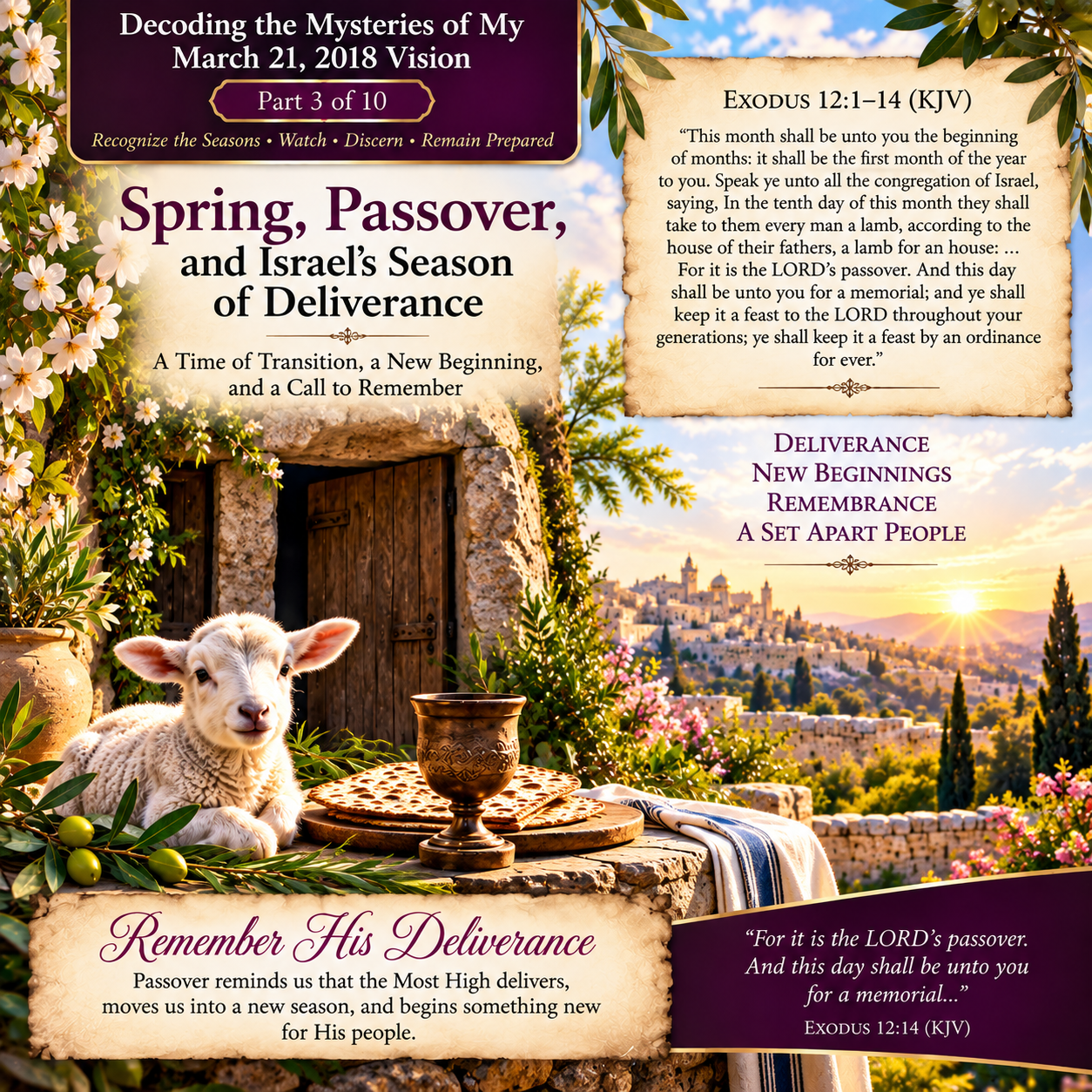
Greetings, my dear brothers and sisters in Christ. The other day, while I was working, I decided to listen to the Gospel of Nicodemus. Here’s a free PDF of the text. The Gospel Of Nicodemus.pdf I wanted to share a summary of each chapter, but I think it’s best for everyone to read the entire book for themselves. The Gospel of Nicodemus, also known in parts of its textual tradition as the Acts of Pilate, presents an expanded narrative surrounding the trial, crucifixion, resurrection, and ascension of Jesus Christ. The latter portion of the work goes beyond the events witnessed on Earth and presents an account of Christ’s descent into the realm of the dead, the liberation of the righteous who were held there, and their entrance into Paradise. Throughout the Gospel, testimony plays an important role. Witness after witness is brought forward concerning Jesus’ works, his death, his resurrection, and eventually what occurred within the unseen realm after his death.

Chapter I — Jesus Is Brought Before Pilate

The Gospel begins with Annas, Caiaphas, Summas, Datam, Gamaliel, Judas, Levi, Nephthalim, Alexander, Jairus, and other Jewish leaders bringing accusations against Jesus before Pontius Pilate. They accuse Jesus of being born through fornication, practicing sorcery, violating the Sabbath, and claiming to be the Son of God and a king. Pilate questions what they mean by saying Jesus is a king, and the accusers insist that Jesus himself has made such claims. Pilate initially tells them to judge Jesus according to their own law, but they answer that they are not permitted to put anyone to death.

When Jesus is summoned, something unusual occurs. The messenger sent to bring him treats Jesus with great respect. He spreads his cloak before him and asks Jesus to walk upon it. The Jewish authorities become angry and accuse the messenger of honoring Jesus improperly. The messenger explains that when he had previously been in Jerusalem, he saw the Hebrew children honoring Jesus and crying out praises as Jesus entered the city.

Pilate then attempts an experiment. He instructs the standards held by his standard-bearers to be firmly held as Jesus enters. Nevertheless, when Jesus comes into the hall, the standards bow toward him. The authorities accuse the standard-bearers of deliberately lowering them, so Pilate replaces them with stronger men chosen by the accusers themselves. Yet when Jesus enters again, the standards once more bow before him. From the very beginning of the Gospel, therefore, the narrative establishes a contrast between those accusing Jesus and signs that appear to testify to an authority they do not recognize.

Chapter II — Pilate Questions Jesus About His Kingship

Pilate begins questioning Jesus personally. The central issue is whether Jesus considers himself the King of the Jews. Jesus asks whether Pilate is asking this question from his own understanding or because others have told him these things. Pilate responds that he is not a Jew and explains that Jesus’ own nation and chief priests have delivered him for judgment.

Jesus then explains the nature of his kingdom. His kingdom is not presented as an earthly political kingdom defended through ordinary military power. He explains that if his kingdom belonged to this world, his servants would fight to prevent him from being delivered to the Jews. Pilate recognizes from Jesus’ answer that he is nevertheless acknowledging kingship in some sense.

Jesus explains that he came into the world to bear witness to truth and that those who belong to truth hear his voice. Pilate responds with the famous question concerning the nature of truth. After questioning Jesus, Pilate does not find sufficient grounds for condemning him. The conflict therefore becomes increasingly clear: Jesus is accused of earthly sedition, yet his own explanation points toward a kingdom whose nature exceeds earthly political authority.

Chapter III — Pilate Declares Jesus Innocent

Pilate returns to the accusers and announces that he finds no fault in Jesus. Rather than accepting this judgment, the accusers intensify their claims. They insist that Jesus has stirred up the people throughout the region, beginning from Galilee and continuing to Jerusalem.

Pilate becomes increasingly troubled by their persistence. He asks whether Jesus is a Galilean and learns of his connection with Herod’s jurisdiction. Yet the accusations continue to center upon Jesus’ teachings, authority, and influence among the people.

The chapter develops the growing tension between Pilate’s reluctance to condemn Jesus and the determination of his opponents to obtain judgment against him. The narrative is deliberately building a record in which Jesus’ condemnation does not arise because Pilate independently discovers a crime worthy of death. Instead, Pilate repeatedly questions the accusations and expresses uncertainty concerning the case being presented before him.

Chapter IV — Witnesses Begin Speaking for Jesus

As the proceedings continue, individuals begin coming forward who challenge the accusations against Jesus. Nicodemus becomes an important voice. He reminds the assembly that their own law requires proper examination before a person is condemned. His intervention shifts attention toward the works Jesus has performed and whether those works truly justify the accusations being made against him.

Nicodemus speaks concerning the extraordinary signs associated with Jesus and challenges the authorities to consider whether such works could be accomplished if God were not somehow working through him. The opposition rejects this reasoning and continues attempting to discredit Jesus and those who defend him.

The importance of Chapter IV lies in the Gospel’s growing emphasis upon testimony. The reader is not simply being told what to believe about Jesus. The narrative begins assembling witnesses. This pattern will continue throughout the Gospel and eventually become central to its account of the resurrection and the world of the dead.

Chapter V — Those Healed by Jesus Testify

Chapter V introduces people who claim personally to have experienced Jesus’ healing power. Their testimonies challenge the accusation that Jesus is merely an evil worker of sorcery. One person describes being afflicted for many years before encountering Jesus and receiving healing. Others testify concerning blindness, infirmity, and different physical afflictions from which they were restored.

The chapter also recalls the raising of Lazarus. Witnesses testify that Lazarus had been dead and that Jesus restored him to life. This testimony becomes especially significant later in the Gospel because Lazarus’ resurrection is eventually discussed from the perspective of the powers of the realm of death itself.

The chapter establishes a recurring pattern: people whose lives and bodies were restored by Jesus become witnesses concerning him. His earthly ministry is characterized by restoration, healing, release from affliction, and even victory over physical death. These earthly works anticipate the much greater confrontation with death described later in the Gospel.

Chapter VI — Further Testimony Concerning Jesus

The controversy continues as additional testimony is presented. Questions concerning Jesus’ birth and identity become important because his opponents attempt to discredit him through accusations concerning his origins. Individuals familiar with the circumstances surrounding his family and birth challenge some of these accusations.

The narrative therefore expands beyond the question of individual miracles. Jesus’ identity itself is being investigated. Different groups interpret him in radically different ways. His opponents see deception, illegitimacy, and danger, while others see evidence of divine favor and extraordinary power.

This uncertainty concerning Jesus’ identity becomes one of the driving questions of the Gospel. The earthly proceedings cannot fully resolve it. The answer gradually emerges through the accumulation of testimony and reaches its greatest expression only after Jesus has died and the narrative moves into the spiritual realm.

Chapter VII — Pilate’s Wife Is Troubled Because of Jesus

The proceedings are interrupted by a message from Pilate’s wife. She warns Pilate not to involve himself with the righteous man Jesus because she has suffered greatly in a dream because of him. Pilate takes the warning seriously and confronts Jesus’ accusers with it.

The authorities attempt to dismiss the warning by connecting it with their accusation that Jesus possesses magical or deceptive powers. Nevertheless, the warning adds another layer to Pilate’s hesitation. He is already unable to find sufficient fault in Jesus, witnesses have testified concerning Jesus’ works, and now his own household has been disturbed by a warning concerning the man standing before him.

The chapter contributes to the growing sense that events surrounding Jesus cannot be understood merely as an ordinary criminal proceeding. Something greater is unfolding, although the people participating in the trial do not yet fully understand what it is.

Chapter VIII — The Crucifixion and the Signs Surrounding Jesus’ Death

The narrative moves toward Jesus’ condemnation and crucifixion. Jesus is delivered to be crucified, and the Gospel describes the events surrounding his death. Extraordinary signs accompany the crucifixion, including darkness and disturbances that cause fear among those witnessing what is happening.

Most importantly for the later chapters, graves are opened and the bodies of certain saints arise. At this stage the Gospel does not yet explain fully what has happened to them. That mystery is deliberately left unresolved until Joseph of Arimathaea later identifies individuals who have returned from the dead.

Jesus’ death therefore becomes the great dividing point of the narrative. Until now, the Gospel has concentrated on earthly accusations, witnesses, miracles, and judgment. After the crucifixion, attention increasingly turns toward resurrection and ultimately toward events occurring beyond ordinary mortal perception.

Chapter IX — Joseph of Arimathaea Buries Jesus

Joseph of Arimathaea becomes central to the story. He asks for Jesus’ body and places it in a tomb. Joseph therefore becomes an important witness to the reality of Jesus’ physical death and burial.

Joseph’s actions anger those opposed to Jesus, and Joseph himself becomes the object of their hostility. He is confined under guard. The authorities believe they have successfully secured him, but something occurs that they cannot explain.

Joseph’s imprisonment creates a smaller version of the larger spiritual pattern that will later unfold. A righteous person is confined behind a barrier that appears impossible to escape. Yet divine intervention will enter that confinement and bring him out.

Chapter X — Reports of the Resurrection Spread

Reports concerning Jesus being alive begin circulating. The authorities investigate what has happened, and testimony concerning the empty tomb and resurrection creates increasing confusion.

The guards and other witnesses become important because the authorities must now explain how a man whose death and burial had been witnessed is reportedly alive. Attempts are made to control or challenge the testimony, but the number of unusual events continues growing.

The central question has shifted. Earlier the question was whether Jesus deserved death. Now the question is whether death actually succeeded in holding him.

Chapter XI — Jesus Delivers Joseph From Confinement

Joseph eventually explains what happened while he was imprisoned. While he was praying, the place was surrounded by extraordinary light, and Jesus appeared to him alive. Joseph initially believed he might be seeing a spirit, but Jesus reassured him and showed him evidence establishing his identity. Jesus takes Joseph by the hand and leads him from his confinement. Joseph is shown the tomb and eventually returned safely to his own home.

This scene becomes especially important when the later descent into the realm of the dead is considered. Joseph experiences confinement, supernatural light, the appearance of Jesus, being taken by the hand, and deliverance. Later Adam will experience a remarkably similar pattern on a much greater spiritual scale: Christ enters the darkness of the dead, takes Adam by the hand, and leads him from captivity.

Chapter XII — Charinus and Lenthius Are Found Alive

Joseph reveals that Jesus’ resurrection is not the only extraordinary event. He tells the authorities that others who had previously died have also risen. Among them are two sons of Simeon, later identified as Charinus and Lenthius. Their deaths and burials were known, yet their tombs are now open and the men are alive. They are found in Arimathaea engaged in prayer. Strangely, however, they do not freely converse with other people.

The authorities bring them to Jerusalem and ask them to reveal what happened after their deaths and how they were raised. The men tremble and initially respond with great caution. Eventually they ask for writing materials so that each can separately record what he witnessed. With this chapter the Gospel crosses from testimony concerning resurrection into testimony concerning the realm experienced by the dead themselves.

Chapter XIII — A Great Light Appears Among the Dead

Charinus and Lenthius begin their testimony. They describe themselves as being with their fathers in the depths of the realm of the dead, surrounded by profound darkness. They are not unconscious. Adam, the patriarchs, prophets, Simeon, John the Baptist, and others retain identity, memory, communication, and awareness. Suddenly a magnificent light appears. It is described with the brilliance of the sun, golden in appearance and accompanied by a purple-colored light that illuminates the place.

Adam recognizes the light as the announcement of everlasting light and deliverance. Isaiah recalls his prophecy concerning those dwelling in darkness and the shadow of death seeing a great light. Simeon testifies concerning the infant Jesus whom he had held in the Temple. John the Baptist then appears among them and identifies himself as the one who prepared the way of Jesus among the living. His ministry as forerunner now continues among the dead. He announces that the Son of God is coming to visit them. The entire realm begins anticipating the arrival of Christ.

Chapter XIV — Seth, Michael, and the Tree of Mercy

Adam asks his son Seth to recount an ancient event. While Adam was sick, he had sent Seth toward the gates of Paradise to seek the oil of the Tree of Mercy for healing. At the gates Seth encountered Michael the Archangel. Michael explained that the requested oil could not yet be given. Instead, he foretold a future restoration connected with the coming of Christ. Christ would come to Earth, raise Adam’s human body and the bodies of the dead, and bring mercy to those who believe.

The prophecy culminates with the promise that Adam will ultimately be introduced into Paradise and brought to the Tree of Mercy. This chapter is important because it establishes that the dark realm in which Adam presently waits is not Paradise. Paradise exists beyond his present condition. Adam’s story has not yet been completed. The restoration promised through Michael requires Christ’s coming, victory over death, resurrection, and Adam’s eventual return to Paradise.

Chapter XV — Satan Warns the Prince of Hell About Jesus

The perspective suddenly changes from the righteous dead to the powers associated with death and Hell. Satan speaks with the Prince of Hell concerning Jesus of Nazareth. Satan initially expects Jesus’ death to result in Jesus entering their domain. Yet the Prince of Hell becomes alarmed when he realizes this is the same Jesus who demonstrated authority over sickness, demons, and death during his earthly ministry.

The resurrection of Lazarus becomes especially important. The Prince of Hell remembers being unable to retain Lazarus when Jesus commanded him to return to life. This causes him to recognize that Jesus possesses an authority unlike that of ordinary mortals. He warns Satan that bringing Jesus into their realm could result in disaster. Rather than becoming another prisoner, Jesus may release those already held there and conduct them toward everlasting life. Satan’s expected victory through the crucifixion therefore begins to appear as a terrible miscalculation.

Chapter XVI — The King of Glory Comes to the Gates

While Satan and the Prince of Hell are speaking, an overwhelming voice like thunder commands the gates to open so that the King of Glory may enter. The powers within attempt to resist. The gates are ordered shut and strengthened with bars. Meanwhile, the saints recognize what is happening and call for the gates to be opened. David and Isaiah recognize the fulfillment of the sacred words associated with broken gates, shattered bars, liberation of prisoners, and light coming to those dwelling in darkness.

The question is asked: Who is the King of Glory? The answer identifies him as the Lord strong and mighty, powerful in battle. Christ is approaching not as another helpless dead man but as a conquering king entering the territory of death itself. The gates cannot permanently resist him. Christ enters, and places that had previously remained in darkness are illuminated by his presence. Fetters that could not previously be broken are shattered. The deliverance has begun.

Chapter XVII — Christ Conquers Death

The powers of Death are terrified by the brightness accompanying Christ. They cannot understand how someone who has truly died can enter their realm without displaying the corruption and helplessness associated with ordinary death. They recognize the paradox before them: Jesus has died and lain in the grave, yet he has entered their realm alive and possessing authority. Christ releases captives who had been held in chains and restores liberty to those imprisoned. His light illuminates those dwelling in darkness.

The powers below begin realizing the magnitude of Satan’s error. Jesus’ crucifixion did not deliver him helplessly into their hands. His death provided the means by which he entered their realm as conqueror. The chapter culminates with the King of Glory trampling upon Death, overcoming the authority of the Prince of Hell, and taking Adam with him. The one whom death expected to possess has instead begun emptying death’s prison.

Chapter XVIII — Satan’s Plan Is Reversed

The Prince of Hell turns angrily against Satan. He accuses Satan of bringing destruction upon their dominion by arranging the death of Jesus. Christ’s presence has filled their darkness with divine brightness. Their prisons have been broken, captives released, and those who once groaned without hope now rejoice. The Prince of Hell interprets the event through the story of Adam. Humanity’s loss began with the forbidden tree and the loss of Paradise. Now the wood of Christ’s cross has become the instrument through which Satan’s earlier victory is reversed. The chapter presents the crucifixion as a great reversal. Satan believed the cross would destroy Jesus. Instead, the cross becomes the means through which the power of death is broken. Christ then commands that Satan himself be placed under the dominion of Hell in place of Adam and Adam’s righteous descendants, who now belong to Christ. The captor becomes captive while the captives are liberated.

Chapter XIX — Christ Takes Adam by the Hand

Christ calls the saints to himself. The righteous gather beneath the hand of God, and Christ personally takes Adam by the hand. This is one of the central images of the entire Gospel. Adam, representing humanity’s ancient fall and exile, is not merely told that freedom is available. Christ reaches toward him, takes hold of him, and leads him out. Adam falls before Christ in gratitude, praising God for bringing his soul from the grave and delivering him from the pit. The saints likewise praise Christ as Redeemer and acknowledge that he descended to deliver them from Hell and death. Christ marks Adam and the saints with the sign of the cross. Then the Gospel explicitly says that Christ ascends from Hell, holding Adam by the right hand, while the saints follow him. The prophets praise God during the ascent. What began as a gathering of souls sitting in darkness has become a procession of liberated saints following Christ upward.

Chapter XX — Michael Leads the Saints Into Paradise

After the ascent, Christ delivers Adam into the care of Michael the Archangel. Michael then leads Adam and the company of saints into Paradise, which the Gospel describes as filled with mercy and glory. Inside Paradise they encounter two ancient men whom they did not previously see among the dead. These men identify themselves as Enoch and Elijah. Enoch explains that he was translated by the word of God, while Elijah was taken by a fiery chariot. They therefore did not experience the same route through death as Adam and the other saints.

Another man then appears carrying the sign of the cross. He identifies himself as the thief who was crucified beside Jesus. He explains that after acknowledging Jesus and asking to be remembered in his kingdom, Jesus promised that he would be with him that day in Paradise. The thief says Jesus gave him the sign of the cross and instructed him to go to Paradise. When the angel guarding Paradise saw the sign and heard that Jesus had sent him, the gates were opened and the thief was admitted. The guardian instructed him to wait because Adam and his righteous descendants would soon arrive. The promise is now fulfilled. Adam, the saints, Enoch, Elijah, and the repentant thief are brought together within Paradise. The movement that began in darkness has reached its destination: captivity has become liberty, darkness has become light, and exile has become entrance into Paradise.

Chapter XXI — The Witnesses Complete Their Testimony

Charinus and Lenthius now explain that what they have revealed represents only those mysteries they were permitted to disclose. According to their testimony, Michael had forbidden them from revealing certain other mysteries. Michael had instructed them to return to Jerusalem, remain in prayer, and initially refrain from ordinary conversation. This explains why they were found alive but unwilling to speak freely. They also reveal that many others had risen from the dead at the time of Christ’s resurrection. Charinus and Lenthius say they had been permitted only a limited period—three days—to remain among the living. During this time they were to celebrate Passover, visit their relatives, bear testimony concerning Christ, and receive baptism in the Jordan. After completing their testimony, the two men hand over their separately written accounts. The writings are compared and are described as agreeing perfectly.

Then something extraordinary occurs. Charinus and Lenthius are changed into exceedingly white forms and disappear from sight. Their mission among the living has ended. The authorities are deeply disturbed by what they have witnessed. Joseph and Nicodemus eventually bring the record of these events to Pilate, who records the proceedings. Thus the Gospel presents the testimony concerning Christ’s descent among the dead as something transmitted through witnesses who experienced the realm themselves, temporarily returned, recorded what they had been permitted to reveal, and then departed.

Chapter XXII — The Final Investigation

The final chapter returns the narrative to Pilate and the religious authorities. Pilate gathers rulers, scribes, and teachers and requests that the sacred writings be examined concerning the expected coming of Christ. The chapter brings together the various forms of testimony that have accumulated throughout the Gospel: Jesus’ miracles, the witnesses who saw him alive after death, the ascension witnesses, the resurrection of Charinus and Lenthius, and their written testimony concerning what Jesus accomplished among the dead. The sacred book is searched, and the narrative returns to the ancient prophecy involving Adam, Seth, Michael, and the promised coming of Christ. A chronology is presented that the text interprets as pointing toward the appointed time of Christ’s appearance. The dimensions of the Ark are also given a symbolic interpretation connected with this chronology, and the body itself is described through the imagery of an ark or tabernacle.

The final conclusion of the Gospel concerns the identity of Jesus. The one who was originally brought before Pilate as an accused man, condemned, crucified, and buried is ultimately proclaimed within the narrative as Jesus Christ, the Son of God. The Gospel therefore ends where its deepest question began: Who was the man standing before Pilate? The trial could not fully answer the question. The crucifixion appeared to answer it through death. The empty tomb challenged that answer. The resurrection witnesses challenged it further. The ascension opened the question toward heaven. And the testimony of Charinus and Lenthius carries the reader beneath the Earth, where even the powers of death are depicted as discovering that the crucified Jesus cannot be held.

The Complete Journey of the Gospel of Nicodemus

When the Gospel of Nicodemus is read from beginning to end, it forms one continuous movement from accusation to revelation.

Jesus first stands before human judges while people argue about who he is. Witnesses testify concerning his works, but opposition remains. Pilate repeatedly questions whether Jesus deserves condemnation. Nevertheless, Jesus is crucified and buried. For a moment, death appears to have given the final answer. But then the direction of the narrative reverses. The tomb is opened. Jesus appears alive. Joseph is miraculously delivered. Witnesses testify concerning the resurrection and ascension. Then two men who had actually died appear among the living and reveal what occurred beyond the grave. Their testimony opens an entirely different dimension of the story.

The righteous dead are conscious in darkness. Adam and the prophets wait. A magnificent light suddenly appears. Isaiah recognizes it. Simeon recognizes its meaning. John the Baptist announces that Christ is approaching. Meanwhile, Satan and the Prince of Hell discover that the crucifixion has produced something they did not expect. The King of Glory comes to the gates. The gates are commanded to open. Christ enters. Darkness becomes light. Fetters break. Prisons open. Death is overcome. The captives are liberated. Then comes the image at the heart of the story: Christ takes Adam by the hand. Adam rises. The saints gather. Christ ascends from the realm of the dead, and the saints follow him. Michael receives the liberated company and leads them into Paradise.

There they encounter Enoch and Elijah, who had been translated, and the repentant thief, who had already been admitted through the gates by the authority of Christ. Charinus and Lenthius then temporarily return among the living so that the story of what occurred among the dead can be told. They record their testimony, complete the purpose for which they returned, change into brilliant white forms, and disappear. The narrative therefore presents the death and resurrection of Christ as something much greater than the reopening of one tomb. Within the framework of the Gospel of Nicodemus, it is portrayed as a cosmic act of deliverance and restoration.

The movement of the story can be summarized as:

Trial → Condemnation → Crucifixion → Death → Descent → Darkness → Divine Light → Gates Opened → Captivity Broken → Adam Raised → Saints Gathered → Ascent → Paradise → Testimony.

The Gospel begins with human beings asking whether Jesus is truly a king. It ends after depicting him entering the kingdom of Death itself, breaking its captivity, taking humanity’s ancient father Adam by the hand, and leading the righteous toward Paradise. In that sense, the Gospel of Nicodemus presents its deepest answer to the question of Jesus’ identity not merely through what people say about him during his earthly trial, but through what happens when he crosses the boundary of death itself.

The End of Days & the Day of Judgment: The Cyclical Return of the Celestial God Nibiru & the Anunnaki!

Shalom Brothers and Sisters of Christ! I just wanted to share some information from the Lost Book of Enki and how it aligns with biblical texts. Many of us are aware of the end time prophecies and it has something to do with the cyclical return of the celestial God Nibiru and the Anunnaki. The Lost Book of Enki explains it very well and makes sense. Rather than trying to guess or figure out what’s ahead, we already have earlier writings that inform us about events to come in the future and it’s prophetic. The Lord Enki said the following.

In the future shall it be judged, for at the end of days a Day of judgment
there shall be. On that day the Earth shall quake and the rivers shall change course, and there shall be darkness at noon and a fire in the heavens in the night, the day of the returning celestial god will it be. And who shall survive and who would perish, who shall be rewarded and who will be punished, gods and men alike, on that day shall it be discovered; for what shall come to pass by what had passed shall be determined; and what was destined shall in a cycle be repeated, and what was fated and only by the heart’s will occurring for good or ill shall for judgment come.

Within the framework of The Lost Book of Enki, Enki is describing a future cosmic judgment tied to the return of a celestial force connected to cyclical destruction, moral accountability, and the restoration of divine order. The passage reads like a prophetic decree where heaven, Earth, and humanity are all drawn into a final reckoning. The statement “at the end of days a Day of judgment there shall be” mirrors the Biblical idea of a final appointed time when hidden actions are revealed and all beings stand before divine judgment. In this framework, Enki is saying that history itself is cyclical and what happened in ancient times will happen again. The past becomes a prophetic template for the future. This aligns with the Biblical pattern language of “as it was in the days of Noah” before the return of the Son of Man.

When trying to understand what might happen before the return of Yahshua, we should connect it to the return of the celestial God Nibiru. Why? Because it’s seen as a heavenly sign linked to the ancient disaster of the Great Flood. Why else would Yahshua compare it to the days of Noah? It’s important to grasp what was occurring in the heavens and on earth during that period and what events led up to the Great Flood. Most people focus only on what’s happening here on Earth, but we should look up and notice the signs in the heavens. During the days of Noah, a message of repentance went forward to the people on the earth, yet few people repented. Well, that’s the same thing that is happening today. Some people are talking about the return of the celestial god Nibiru, and while only a few believe it, ancient texts do describe Nibiru.

So, it’s very clear that people are not paying attention. Nibiru will come like a thief in the night. People are not expecting the return of Nibiru but it’s already here in our Solar System. Most end-time disaster events are described as the effects of Nibiru approaching the inner solar system. We’ll witness changing weather patterns, with floods, earthquakes, volcanic eruptions, and extreme weather events happening all over the world. For many years I believed that the sign of the Son of Man in heaven was the sign of Nibiru returning. For me Nibiru represented the Day of the Lord because it symbolized the coming of divine judgment from the heavens. The return of Nibiru would be a day of judgment on the Earth. The Great Flood seemed symbolic of God’s judgment on the wicked of the earth. It was as though celestial forces swept away the wrongdoers, carrying them off in the floodwaters.

In essence, death itself served as their judgment in this case. They didn’t make it through the Day of Judgment, but Noah and his family were saved. This highlights Noah’s righteousness, as he survived the Great Flood by being chosen. So, if we take what occurred in the past then the same thing would happen in the future when Nibiru returns. It will be the Day of Judgment, the appointed time when the wicked will face the celestial God Nibiru. I imagine many will perish in the catastrophic events, which will arrive like a thief in the night. I suppose you can look at Nibiru as the throne of a celestial God in heaven. Who shall survive and who would perish, who shall be rewarded and who will be punished reflects a cosmic judgment scene where the actions of beings both the angels of God and humanity are weighed and revealed. The judgment of the fallen angels are mentioned in the Book of Enoch.

On earth there is a moment when hidden deeds, intentions, and moral choices are brought into the light during a final reckoning tied to celestial upheaval and the “returning celestial god.” That’s why we are seeing so many things coming into the light right now. All is being revealed! This theme strongly parallels the Biblical imagery of divine judgment, especially the opening of heavenly records or “books” where the deeds of humanity are examined.

In Book of Daniel 7:9–10, Daniel sees a heavenly court convened at the end of an age:

“I watched till thrones were put in place,
And the Ancient of Days was seated;
His garment was white as snow,
And the hair of His head was like pure wool.
His throne was a fiery flame,
Its wheels a burning fire;
A fiery stream issued
And came forth from before Him.
A thousand thousands ministered to Him;
Ten thousand times ten thousand stood before Him.
The court was seated,
And the books were opened.”

This scene resembles a cosmic tribunal. The “books” symbolize the records of deeds, intentions, and actions. In the Lost Book of Enki framework, judgment also comes after cycles of corruption, catastrophe, and moral failure. Both the bible and the Lost Book of Enki portray a heavenly administration reviewing the conduct of beings before determining outcomes.

Another judgment scene in the Book of Revelation 20:11–15:

Then I saw a great white throne and Him who sat on it, from whose face the earth and the heaven fled away. And there was found no place for them.
And I saw the dead, small and great, standing before God, and books were opened. And another book was opened, which is the Book of Life.
And the dead were judged according to their works, by the things which were written in the books. The sea gave up the dead who were in it, and Death and Hades delivered up the dead who were in them.
And they were judged, each one according to his works.”

In these judgment scenes we see cosmic disturbance, heaven and earth shaken, records opened, reward and punishment, judgment according to deeds. All of this correlates to the return of Nibiru because it’s a day of judgment for many people just like during the Great Flood. What was destined shall in a cycle be repeated resembles the Biblical pattern that history repeats itself spiritually and morally. Yahshua compares the final days to ancient cycles already seen before.

In Gospel of Matthew 24:37–39: 37 But as the days of Noah were, so shall also the coming of the Son of man be. For as in the days that were before the flood they were eating and drinking, marrying and giving in marriage, until the day that Noe entered into the ark, And knew not until the flood came, and took them all away; so shall also the coming of the Son of man be.

Both the Lost Book of Enki passage and Biblical prophecy describe a returning heavenly sign, disturbances in the heavens, global shaking,
moral accountability, and a final revealing of humanity’s spiritual condition. The “returning celestial god” in the Lost Book of Enki framework functions similarly to the Biblical concept of the “Day of the LORD” which is a moment when heaven intervenes directly in the affairs of Earth and the hidden state of humanity is brought into judgment. Everyone is waiting for the return of the Lord, unaware that it’s actually about the return of the celestial god Nibiru. Yahshua exists in a higher realm, a higher dimension, and operates within a higher heaven.

I can’t fully explain everything I’ve received and been shown, but Yahshua was inside a celestial ship in heaven, it was a heavenly chariot. In my vision I was caught up in a heavenly ship that was at first cloaked and hidden in dark clouds. Then I found myself in space, or perhaps heaven. I assumed this heavenly ship was an interdimensional craft capable of navigating both lower and higher dimensions. I’ve spent a long time wondering about the day Yahshua will return, and it’s still a mystery to me. There’s no single answer to this question. I saw the chariots returning in my dreams and I was taken aboard the ship. The only sign in the dream that it was the return of Yahshua was when a man asked the being who came to get me, “Is this the return of Jesus (Yahshua)?” and the being replied, “Yes!” For me, that’s what the Most High and the angels revealed in my dream. I felt really happy in it, but will it happen that way? I’m not sure. Many people have received dreams and visions over the years, and sometimes they don’t unfold exactly as we saw them.

Many of us long for Yahshua’s return, but we might not live to see that day. It could be an event far in the future, and perhaps we’ve been given a glimpse of what’s to come in a time yet ahead. I’ve had dreams and visions since 2012, and have I seen things come to pass? Yes. But I want the chariots to come. They’re here, up in our skies, but who knows how much longer until they deliver us? I sure don’t. In the meantime, we’re stuck on Earth going through trials and tribulations. My life has taken a turn for the worse, and it hasn’t been good. It’s been nothing but pain, misery, and suffering, with no relief in sight. I feel like giving up yet I keep pressing forward hoping for something good to happen to me.

I am experiencing a time of great tribulation. It’s not coming it’s already happening NOW and I’m just trying to endure. During this period of tribulation there is uncertainty. I am unsure if I will make it through this great tribulation. Honestly, I’m feeling troubled, worried, and stressed out. My soul cries out in deep distress as my body suffers under the grip of pain and illness. My bones aches and much more is happening. I call out to the Lord for deliverance and healing, yet it hasn’t come. I feel as though I’m under judgment, with no clue what I’ve done wrong. I repented of my sins and rededicated my life to Christ in July 2012. I spend most of my time seeking the Creator. On July 3, 2012 I invited the Holy Spirit to descend upon me in my home. I have sought spiritual guidance and wisdom from the Most High, asking to be purified and cleansed. Now I’m going through a great tribulation, being refined by fire, but I didn’t expect the suffering that would come with it. I feel like Job in the Bible.

I feel like I’m on trial, with my faith constantly being tested. It’s as if I’m under attack, caught in the middle of spiritual warfare, and my enemy wants me to suffer. I keep wondering why the righteous have to endure so much pain. I ask the Lord this question often, but I still don’t understand why the righteous must suffer repeatedly. How much more are we expected to bear? It almost feels like you need to prove your righteousness before God’s throne. It’s like no matter what is thrown at me I still have my faith in Yahshua. I love God whether I’m doing well or facing challenges, because he is always with me. I just keep my eyes on the Lord when I am not feeling well. During my troubles, that’s all I can focus on. Yahshua keeps me steady, grounding me with thoughts of his love and the love within me. I just remember him in my dreams, and it feels like he’s right there with me. Love is the one thing in my heart that keeps me moving forward. Without love, there is no life. If you’re going through tough times, hold on and stay strong. Pray, keep hope alive, and hold on to your faith no matter what life throws at you. In the midst of your struggles, don’t turn away from God draw closer to him instead.

I’m going to move on to something I discovered while looking at Mysteries of the Dead Sea Scrolls Exposed, Vol. 1-3 by Dr. Frank E. Stranges. I thought it was very interesting, so I wanted to share it. He mentioned what was found in the Copper Scrolls in Cave #3.

The Master speaking, “Do not permit your pure mind to become troubled in any form but rather allow your faith and your belief to solely rest in Almighty God. You believe whole-heartedly in Almighty God, you also believe in Me with all of your heart, mind and spirit. In our universe, which I have created, there are multitudes of places and orbs which, along with the Earth, shall be your future dwelling places.”

“I have already prepared many places for you to visit and to also dwell in the future. In reality, because I Am God, I shall be with you always everywhere and will always accompany you. And when the time is ripe you shall know that I have already made a way for you to be transformed and then you shall dwell with me in those other places. In that manner, we shall never be apart again for I shall be with you, always.”

“I have already made provisions so do not allow your pure mind, your pure heart or your spirit to become disturbed. I am well aware that the evil one and his followers have already tried and tempted you and attempted to try your faith. He is very busy and his evil activities shall increase as the time of the end shall appear.”

“His own angels whom I have cast out of the Heavenlies, down to Earth, are busy attempting to, in every way, to destroy your faith. But youmy children shall be assisted by My Angels and other Heavenly Messengers, who will reveal themselves in chariots of fire. They will bring you a message that will cause you to be encircled with My Holy Flame of Fire that will cause much discomfort to the enemy. They shall also minister to you and protect you because I have assigned them to do so with the word of my mouth. I have spoken thus.”

“Now I shall leave you for but a brief season. Meanwhile, My Spirit shall accompany you always. You will never be comfortless. Even so I am with you always even unto the time of the end. My love shall embrace you as never before. For I am the Lord that changes not and I shall keep My word.”

These passages gave me hope because when I saw Yahshua on the chariot in my dream, he told me he would come back for me. It felt like a promise. I knew Yahshua would return someday, and when he did, I’d be with him again. The whole scene pointed to the place he has prepared for his people. In the midst of my struggles, I think about the place in heaven prepared for the righteous. I believe our suffering won’t last forever, and there’s something beautiful and good to look forward to in the kingdom of heaven. The passages attributed to the so-called Copper Scroll writings present a profound and cosmic message of comfort, protection, transformation, and divine reunion during the time of the end. When I was aboard the chariot it felt like a family reunion. There was a gathering aboard the ship, and we all stood before the throne room. A figure sat in a chair in the room where we had gathered. I don’t recall his face, but I was called to sit next to him.

But back to what was revealed in the passages. The voice speaking in the passages reassures humanity not to become fearful as darkness and spiritual conflict increase upon the Earth. This is definitely happening right now on the earth. The message is deeply apocalyptic in tone, yet at its core it is also a message of hope. I had a dream about seeing Yahshua on a chariot, surrounded by a gathering of people, and it filled me with hope. It felt like a moment where everyone was coming together on the chariot. In the passages, it speaks of heavenly assistance, spiritual warfare, angelic intervention, and the preparation of future dwelling places beyond this world.

The opening words immediately echo the teachings of Yahshua found in the Gospel of John:

“Let not your heart be troubled: ye believe in God, believe also in me.” — Gospel of John 14:1 (KJV)

The master calls upon believers to preserve the purity of your mind, heart, and spirit despite the increasing turmoil surrounding you. One of the first steps to maintaining purity is finding stillness and inner balance. Constant noise, conflict, outrage, fear-driven media, and emotional turmoil scatter the mind and drain spiritual focus. Stillness brings back a sense of order within. Book of Psalms 46:10 (KJV): “Be still, and know that I am God.” This is emotional encouragement; and it is a warning that the final days would bring intense spiritual pressure designed to weaken faith and create fear within humanity. It seems that people’s faith is fading as they go through trials, hardships, and challenges. The text depicts the mind and heart as sacred vessels meant to stay in harmony with the divine, rather than being overtaken by anxiety, confusion, or despair. Sometimes, in the middle of my struggles, I put in a lot of effort to restore inner equilibrium and it’s tough. I attempt to turn inward to find my center, instead of being swept away by the emotional chaos happening around me and in the world. It’s just too much happening at one time.

Now on to something more exciting. In the passage is the declaration that within the Creator’s universe there are “multitudes of places and orbs” prepared as future dwelling places. This concept expands far beyond the traditional earthly understanding of existence. The term “orbs” evokes imagery of celestial worlds, heavenly realms, planetary domains, or dimensions prepared for future habitation. This mirrors the words of Yahshua:

“In my Father’s house are many mansions: if it were not so, I would have told you. I go to prepare a place for you.”— Gospel of John 14:2 (KJV)

Within the framework of these passages, Earth is not portrayed as the final destination of humanity, but rather as one realm within a much greater cosmic order. Humanity is depicted as participating in a larger divine plan involving many worlds and many dwelling places. The message suggests that existence extends beyond the visible Earth into a vast universe filled with prepared realms under divine governance.

The text then introduces the idea of transformation. The master says that when the proper time arrives, a way has already been prepared for humanity to be transformed so they may dwell eternally in those higher places. This parallels the Biblical mystery of glorification and spiritual transformation described by the Apostle Paul:

“Behold, I shew you a mystery; We shall not all sleep, but we shall all be changed, In a moment, in the twinkling of an eye…” — First Epistle to the Corinthians 15:51–52 (KJV)

The concept of transformation implies more than physical relocation. It suggests a change in state, consciousness, and being itself. Humanity is portrayed as moving from corruption into incorruption, from limitation into higher existence. This idea has appeared throughout ancient mystical traditions as ascension, glorification, transfiguration, or the awakening of the heavenly nature within humanity. The passages also reveal a strong theme of spiritual warfare. The “evil one” and his followers are described as actively working to destroy faith and destabilize humanity as the time of the end approaches. This directly parallels the Biblical concept of increasing deception and darkness in the last days. The text speaks of fallen angels cast down from the heavenly realms who now operate upon the Earth attempting to corrupt, discourage, and mislead humanity.

This imagery strongly resembles the war in heaven described in Revelation: And there was war in heaven: Michael and his angels fought against the dragon; and the dragon fought and his angels and prevailed not; neither was their place found any more in heaven. And the great dragon was cast out, that old serpent, called the Devil, and Satan, which deceiveth the whole world: he was cast out into the earth, and his angels were cast out with him. – Revelation 12:7-9

The Earth becomes the battleground between higher and lower spiritual forces. Humanity stands in the center of this conflict, influenced either toward divine alignment or toward corruption and spiritual destruction. Yet the message does not end with fear. Instead, it promises heavenly intervention. The text declares that believers will be assisted by angels and “Heavenly Messengers” who will reveal themselves in “chariots of fire.” This imagery is one of the most fascinating elements in the passage because it connects directly to ancient Biblical descriptions of divine vehicles and heavenly manifestations. I hope for and look forward to divine intervention, with heavenly messengers and angels arriving on Earth in chariots. Honestly this is what people think of as the rapture event, but this involves the chariots.

The prophet Elijah was taken into heaven in a whirlwind accompanied by a fiery chariot: As they were walking along and talking together, suddenly a chariot of fire and horses of fire appeared and separated the two of them, and Elijah went up to heaven in a whirlwind. -2 Kings 2:11 (KJV) Likewise, the prophet Ezekiel described radiant living beings, wheels within wheels, brilliant fire, crystal expanses, and luminous movement descending from the heavens in his famous vision: “And I looked, and, behold, a whirlwind came out of the north, a great cloud, and a fire infolding itself, and a brightness was about it, and out of the midst thereof as the colour of amber, out of the midst of the fire.” Book of Ezekiel 1:4 (KJV)

Within the mystical framework of the Copper Scroll passages, these “chariots of fire” symbolize divine transportation, heavenly technology, angelic manifestation, or vehicles of spiritual authority descending from higher worlds. Heavenly messengers are appointed as protectors and guides, sent to support and defend the faithful during the final time of trouble. The text also mentions that these heavenly beings will encircle believers with a “Holy Flame of Fire” that brings distress to their enemies. Perhaps the “Holy Flame of Fire” is a symbol of divine protection during times of conflict and chaos, with heavenly chariots surrounding the faithful. The heavenly chariots represent the heavenly army protecting the children of God. In one of my dreams, I saw a chariot above me and everywhere I went the chariot followed me. Then I saw military jets shooting at the chariots in the sky that were watching over me. It clearly shows war in heaven. I had another dream where I was walking through an air force base, and a fire broke out. One of the guardian angels jumped in front of me, shielding me from the flames. I think there had been an air strike at the base, and God was showing me how the angels are our protectors and guardians during times of war and chaos. I always saw the chariots and the angels protecting me during times of conflict on earth, so I know they are here with us.

The Israelites were guided by a pillar of fire in the wilderness. I believe there were chariots guiding the children of Israel from above in the clouds of heaven. I believe we have heavenly protection against darkness. I think we should look to Christ and keep asking the heavenly Father for help and divine protection each day. The message ultimately culminates in a promise of continual divine presence: “You will never be comfortless…” Again echoing the words of Yahshua: “I will not leave you comfortless: I will come to you.”— Gospel of John 14:18 (KJV) In these dark days, may Yahshua manifest himself to me and to all those who seek his peace, comfort and divine presence.

These copper scrolls tell a story of cosmic redemption unfolding in the midst of intense spiritual warfare. The faithful are told not to fear because higher realms already exist, transformation has been prepared, heavenly messengers will intervene, divine protection will surround us, and ultimately humanity’s destiny extends beyond the Earth itself. I’ll try to focus on these things, as they’re meant to inspire hope and faith. The passages portray the end of days as transition, the closing of one age and the opening of another. The universe itself is filled with prepared dwelling places awaiting the awakening and transformation of humanity into a higher state of existence with the divine presence forever.

Psalm 68:17 (KJV) also says: “The chariots of God are twenty thousand, even thousands of angels…in a vision I saw thousands of chariots in space. I just hope they intervene soon. May Yahshua send his heavenly messengers and angels from higher worlds to surround me during periods of darkness. In this world there are destructive forces that attempt to spread fear, corruption and deception. The whole concept of disclosure day is to deceive more people. These people won’t tell the full truth at all. They have been against the benevolent forces who are here in these heavenly chariots. The scriptures describe how they attempt to fight against Yahshua and his heavenly hosts in Revelation 19 when he returns. It paints a vivid image of Yahshua and the holy ones riding white horses, portrayed as fiery chariots descending from heaven. So once again, the return of Christ seems connected to the return of chariots, and they’re already trying to create an image of aliens invading Earth to instill fear in people. The scriptures show the presence of chariots with God’s people throughout the Bible. The dark forces will attempt to retreat underground when the chariots arrive. They’ve already got their underground bunkers prepared, ready to hide from the return of Nibiru, the Anunnaki, and their judgment.

Here’s more of what was revealed through the dead sea scrolls exposed.

Cave #1 Includes scrolls from the Book of Habakkuk and reveals astounding revelations regarding the end of the world. Advent of earthquakes in places that have never seen earthquakes, storms of immense, enormous magnitudes, flood conditions wiping out lives, property, animals and means of transportation. The scrolls also reveal that there will be governmental, political and religious deception from the highest level. They further reveal the military failure of world governments to reveal the presence of outer space visitors from the skies.

Copper Scrolls Cave #3

“My lesser gods who are called by my name, who have accepted me as their God for eternity, shall have their beginnings of their Glory while still on Earth. My chosen ones are those whose names are recorded in the Book of Life and shall never be blotted out. They shall prosper in the midst of deep waters of depression. They shall be healed by the name of the Holy One. Many shall live joy which no man nor angel shall be able to utter. My chosen ones shall enjoy true fellowship, true communion with my other sons and daughters from other worlds, spheres and dwelling places. The Word of the Lord speaks through my Prophet Jeremiah and again through the mouths of my Latter day prophets and apostles. Hear these words and live circumspectly before the Lord of Hosts and you shall truly, verily prosper in all of your ways.”

(From the Old Testament Book of Obadiah)

    “Think it not strange that I say to you that I will bring you down to the Earth. It is just as easy for me to allow you to climb out of your ground as it is to command that you return to your own habitation.”

    “Know you not that I am not only the God of Earth but God of all other creations. My Heavenly Messengers from afar have been given charge of your comings and your goings. They act, speak, come and go at My Command. They are My Messengers, who have been given charge over you. They are those who will seek out the Children of God who are willing to pay my price and stand in the face of ridicule for My Name Sake. These, of my people, shall represent My Truth that will save the nations.”

    The scrolls continue to reveal the coming change of world currency that will occur without warning. Physical and Spiritual healing will continue despite the warnings of silence by established religion. The secrets of longevity, as shared by friends from other worlds, will be accepted by many people on this planet. It speaks again of visits by earthquakes and the rich, lush, vast lands of serene beauty on the inner parts of this planet, Venus, Mars, Jupiter and many others. Also terms of warning, concerning the approaching plagues and destroying millions who remain on the Earth following the mass evacuation, which will take place within a short period of time following the turn of this century.

    After watching the video, it’s clear that this universe is filled with heavenly beings from other worlds, sent to Earth as divine messengers or emissaries working under the Creator’s authority. The Anunnaki are divine messengers or angelic beings from another world. In the lost book of enki, it is mentioned that they are emissaries. The Lord Enki sent 2 emissaries to Endubsar in the beginning, and they were sent on fiery chariots. The Anunnaki follow the will of the Creator of All, and it’s clear that many of them were granted power, authority, and various angelic ranks in heaven.

    Let’s move on, the passages connected with Cave #1 immediately establish an apocalyptic tone. They speak of earthquakes occurring in regions that have never before experienced seismic activity, storms of immense magnitude, devastating floods, and the collapse of social and governmental stability. Nature itself appears to become unsettled as the Earth enters a time of shaking. This stuff is happening now. In scripture, cosmic signs and earthly disasters often appear together as indicators that an age is coming to an end.

    Luke 21: 25-28 And there shall be signs in the sun, and in the moon, and in the stars; and upon the earth distress of nations, with perplexity; the sea and the waves roaring; Men’s hearts failing them for fear, and for looking after those things which are coming on the earth: for the powers of heaven shall be shaken. And then shall they see the Son of man coming in a cloud with power and great glory. And when these things begin to come to pass, then look up, and lift up your heads; for your redemption draweth nigh.

    Nibiru is a sign that will appear in the sky, and it seems that when we witness its arrival, we’ll know the time is near and our redemption is close. I suppose this is when there will be divine intervention and the heavenly chariots will arrive on earth. The scrolls warn of governmental, political, and religious deception emerging from the highest levels of society. This reflects a recurring prophetic theme found throughout scripture: that in the final days confusion and deception increase dramatically. Institutions once trusted begin to fail, truth becomes obscured, and humanity struggles to discern reality amid widespread manipulation. Yahshua warned repeatedly concerning deception in the final days. There are many false prophets in the world, and not everyone who claims to believe in Christ truly follows his teachings. There are many pastors who follow and support the beast/antichrist system, and they claim to be believers in Christ. Anyone who has been supporting Trump and Israel has been deceived. They are a part of the Antichrist/Beast System. Our government has been lying about UFO’s and higher intelligences for a very long time, and this goes back into the 1950’s.

    Our government and military know about the outer space visitors from the skies. The government and the world powers are aware of realties beyond the ordinary understanding of humanity but conceal them from the masses. This world further descends into confusion and instability because this kingdom has been built on lies. I pray that the sons and daughters of Earth can have true fellowship with the sons and daughters from other worlds and dwelling places. It’s time for us to wake up to a higher reality and break free from the fallen angelic forces that have been ruling and controlling the world. I do believe that heavenly messengers are sent from afar under divine command to be guardians and protectors overseeing humanity’s comings and goings. Book of Psalms 91:11 (KJV): “For he shall give his angels charge over thee, to keep thee in all thy ways.”

    These heavenly messengers operate only by divine command. They serve the Creator, fulfilling greater purposes in the unfolding story of the end times. The writings also foretell dramatic changes to world systems, including sudden economic shifts and changes in global currency structures. Throughout apocalyptic literature, the collapse and restructuring of political, economic, and religious systems often accompanies the transition between ages. The shaking of the Earth is mirrored by the shaking of civilization itself. Another intriguing part of the scrolls mentions healing wisdom and longevity secrets passed down by “friends from other worlds.” Here, advanced knowledge about health, life, and spiritual growth is portrayed as coming from higher civilizations or celestial realms. Established religious systems are depicted as resisting or silencing these revelations even as humanity enters a period requiring greater spiritual understanding.

    The passages also speak of vast beautiful lands within the inner parts of the Earth and mention other planetary realms such as Venus, Mars, and Jupiter. These references present a universe alive with hidden worlds, realms, and civilizations beyond ordinary human awareness. The cosmos is envisioned as interconnected and inhabited under divine order. Finally, the scrolls warn of plagues, destruction, and a coming “mass evacuation” occurring before catastrophic events unfold fully upon the Earth. This resembles many ancient salvation narratives like Noah entering the ark before the flood, Lot leaving Sodom before destruction, and the gathering of the faithful before judgment. So, something is definitely being revealed, and I just hope that this mass evacuation happens soon. I am ready to reunite with our heavenly star family. I hope for healing and restoration. Well, that’s all that I have for today. I will further reflect on more things that I discovered in the Dead Sea Scrolls. May we rejoice in hope, be patient in tribulation and continue to pray. -Seraphim Sophia

    The Books Are Open: Righteous Judgment From the Throne of God! A Message to the Children of Light in the Last Days!

    Greetings, my dear brothers and sisters in Christ. Today has been far from great, and I feel compelled to share a message: distance yourselves from those who choose not to align with God. Right now, there’s a battle between the children of light and the children of darkness. Negative energy is spreading across the world, and a dark cloud is forming. Soon, that cloud will cover the earth, and a day of darkness will arrive unexpectedly. Some realize we’re living in the last days, yet believe they still have plenty of time. I urge everyone still living according to the ways of the world to repent and turn away from sin. Return to God and seek forgiveness. Many claim to believe in him, but refuse to fully surrender to His throne.

    They refuse to follow his commands, choosing instead to live in disorder and imbalance. The time comes when enough is enough, and the sins of humanity reach the throne of God. Righteous anger is stirring in heaven because of all the wrongdoing in the world. People are harming the planet and living in wickedness, with little regard for life. Righteous judgment is not just coming—it’s already here, upon all nations and people across the land. The Most High has given us ample time to repent, but that time has been misused as people have done whatever they pleased. Signs have appeared in the heavens, yet humanity continues on its own path.

    There are those with power and authority in the heavens, sitting on holy councils. The heavenly court has convened, the books opened, records reviewed, and decisions made. Soon, these judgments will be carried out. I feel my spirit fired up with a sense of righteous anger. Together with many others who stand for light, I’ve had enough of the evil and injustice in the world and of those who constantly oppose us or wage war against us. We are weary of the attacks and exhausted by spiritual battles. The cries of God’s people have reached the throne of the Most High Yah. He hears our prayers and knows our struggles. The Heavenly Father will send Yahshua to Earth to deliver His people. We must keep our robes clean and not abandon God when times are hard, for He is with us every single day. He sees our pain and suffering. We must remember there is a season for everything under the sun. Hold on, stay strong, and stand firm, even when attacked.

    Don’t let anyone dim your light but shine bright, brothers and sisters. Some people will be jealous, and while many are called, only a few are chosen. Some people are given a task by God but choose not to follow His plan, deciding instead to go their own way or take the path of the world. But the chosen ones keep the commands of the Most High Yah and His son Yahshua. We must have each other’s backs and avoid tearing one another down. Some claim to love God but show no real love, hiding behind shadows and projecting a false image, yet we know they are not truly with us. If the light were in them, they would speak and walk in truth. God’s people must stand united, and if those around you refuse to keep His commands, it’s best to distance yourself so you don’t stray from His kingdom.

    People can talk all day about what they believe, but if their actions don’t match their words, the truth isn’t in them. The Most High is revealing truth to the entire world, and you’ll begin to notice it in your own family, among friends, in your marriage and relationships, and all around—no one is exempt. God sees everything, and all darkness will be brought into His light. Brothers and sisters, prepare yourselves, because Yahshua will return like a thief in the night, and many will be caught completely off guard. People will be partying, indulging, and committing all kinds of sin when the King arrives. Many of his followers have sent out messages to repent and get ready, but few have listened to God’s messengers. Some mock us, and many doubt that we’ve been given power and authority from God. But in the end, they’ll see for themselves when it all comes to pass.

    Many people avoid facing certain truths, hoping to escape God’s judgment, but there will be no avoiding the hall of judgment. Every soul will stand before the throne of God to be judged. When a soul appears before the heavenly court, the Most High Judge and His holy council open the book of life. Nothing is hidden, as the soul’s own light reveals its true condition. The records show the reality of one’s spiritual state. Every soul’s spiritual condition will be reviewed and evaluated. The heart will be weighed against God’s commandments, as the Judge considers purity of character, acts of charity, service to others, selfishness, and cruelty, as well as the soul’s attachment to earthly desires and its spiritual maturity. The Most High judge will decide which region each soul belongs to in the spiritual realms. I hope people’s hearts are free from wrongdoing and filled with love and truth.

    In this life, I’ve often had to defend myself, but after writing this post today I feel no need to do so. My record will speak for itself, and those who’ve pointed fingers will have to face the truth within themselves. We don’t need to argue or justify our actions or words, because our works and deeds will reveal the truth in time. Today, I’m taking a step back to reflect on my words and choosing to stop arguing with someone who constantly makes me feel like I’m in the wrong just for seeking understanding and asking for clarity on things we can’t seem to agree on. I’m tired of the back-and-forth period. I say let the Most High decide and let the truth be revealed before the throne.

    All I want is peace. I’m the kind of person who likes to work things out. I don’t like letting issues build up because eventually they have to come out. I don’t run from problems or avoid them, but I face them head-on. Not everyone is willing to resolve conflicts or confront certain truths. So, I have decided to let people say what they will; I’ll keep doing the work of the Most High. I am no longer going to participate in any arguments anymore. I will remain silent and keep my distance. The Most High has tried to help me with this, but when you care more than others, it can be hard to stay silent. I’ve learned my lesson yet again and some people just don’t want help and are willing to drag you down with them as they sink. Be mindful, my brothers and sisters.

    We love our friends, family, and those we’re in relationships with, but don’t let them drain your energy or attack your character just because you’re striving to live a holy and righteous life for the Most High. Some people will try to make it seem like you’re in the wrong, when in reality, they’re the ones at fault. As I write this, I continue learning through the Holy Spirit, and I will continue seeking heavenly wisdom and sharing the insight that I have. We are all growing and learning together in this world, and if I can bring understanding to others, I’m grateful to do so. My only aim is to bring light into a dark world. If you say you want to change, then follow through. Stop deceiving yourself and others. Let your actions reflect the teachings of Christ. Be honest, take accountability for your choices, and quit blaming others. Look inward, do the shadow work, and focus on healing your own wounds, pain, and trauma. Too many people carry pain, hatred, unforgiveness, bitterness, guilt, and jealousy in their hearts, projecting it onto others. It’s not right, and no one deserves to be treated unfairly. -Seraphim Sophia

    When Archangel Raphael Came, I Rose! Revisiting my Dream on April 20, 2016

    Shalom my brothers and sisters of Christ. I come today with more insight and deeper knowledge to a dream that I had in 2016. For so long I have written down all of my dreams and visions hoping to gain greater understanding and that time has arrived where I am giving a tool to assist me with breaking down all the symbolism that I have been given over time. I am a very creative being and I love expressing myself on a deeper level and now my divine words can come to light in fullness in this world. I’ve written down and spoken that I am awakening to remember so that is exactly what has been happening since my spiritual awakening in 2012. My dreams and visions have been a doorway to unlocking my DNA. For the longest I have been praying for healing for myself and the whole world. Today I remembered a dream where Archangel Raphael appeared, who is an angel of healing carrying the green/emerald ray frequency. Here’s the dream and I want to take another look at it.

    Dream on April 20, 2016: Raphael came the army appeared and I was apart of the army and a weapon was given to me to fight. This brother had grown into a very large tree and he controlled the whole city. Everyone came to worship him and they bowed down to him. It seem like I was the only one who wasn’t possessed or taken over. He made this woman his queen and her daughter killed her for bowing down. There were hundreds of people coming in to give honor and praise to this beast. He was first a human but he transformed into a tree and the tree was very large. The tree had a face it was very strange. This tree sent out a large noise and that’s when people started to come to worship him. He told me that he had a dream and Raphael the Angel appeared in it and it seemed like he was worried about his dream. When I saw the brother grow into that large tree he said it’s happening Raphael is here. Then that’s when an army appeared ready for battle against this man that became this large tree. I shouted to the army and asked for a weapon so I could fight.

    As I reflect on the dream it is a battle vision showing my role in spiritual warfare. I have been dealing with spiritual warfare since the beginning of my spiritual awakening and Archangel Michael and his angels have been protecting me from dark and evil forces. According to this dream I have a connection with Archangel Raphael, and it reveals that I am aligned with the heavenly army of light. I am a mighty warrior of Yah! My ministry was named Mighty Warrior of Yahweh Kingdom Ministries before I changed it to Awakening Higher Self. So, Archangel Raphael is one of the holy archangels in the Book of Enoch.

    1 Enoch 20: 1-8 states, And these are the names of the holy angels who watch. 2. Uriel, one of the holy angels, who is over the world and over Tartarus. 3. Raphael, one of the holy angels, who is over the spirits of men. 4. Raguel, one of the holy angels who takes vengeance on the world of the luminaries. 5. Michael, one of the holy angels, to wit, he that is set over the best part of mankind ⌈⌈and⌉⌉ over chaos. 6. Saraqâêl, one of the holy angels, who is set over the spirits, who sin in the spirit. 7. Gabriel, one of the holy angels, who is over Paradise and the serpents and the Cherubim. 8. Remiel, one of the holy angels, whom God set over those who rise.

    So, let’s look at my dream on a deeper level to see what my higher self is unlocking and revealing. For me it’s about seeing the bigger picture. I’ve been given bits and pieces of a puzzle over time through spiritual downloads and I’m just putting everything together.

    The Man Who Became a Tree = False God / Possessed Power Structure

    So, in symbolism a tree can represent the following: a system or structure (spiritual, political, ancestral), a place of worship or influence, a manifestation of something deeply rooted and far-reaching.

    In my dream the tree had a face which refers to a consciousness that’s been distorted in a false system. The tree became a man, and the tree grew enormous which is symbolic of corrupted power, control, and false worship. The people bowed down to him which means there was mass possession, loss of free will, and spiritual idolatry. The “brother” in my dream became a beast-tree, a symbolic antichrist structure or false hierarchy or system who clearly wanted to be to be worshipped.

    Now let’s look at the woman and her daughter which represents rebellion within the dark kingdom. “He made a woman his queen, and her daughter killed her for bowing down.” This clearly shows a fracturing within the dark system—the daughter sees through the illusion of false royalty. It also suggests inner rebellion within even those who were once deceived. The daughter represents clarity, the soul that cannot tolerate betrayal of truth. It reveals that the daughter refuses to bow down to false gods. It’s clear that I am part of the remnant and I don’t agree with worshipping a false system with false gods because I stand up for the truth. These things are being revealed through me because it’s my dream. It’s about destroying the false grid system that’s been operating for thousands of years. The true people of God are here to help heal and restore the original crystalline grid of Mother Earth. The original grid resonates on a higher frequency of Love and Light. Everything that has been occurring since my divine spiritual awakening has been biblical and it’s taken many years to put everything together to reveal what’s been hidden.

    Alot of spiritual warfare has been happening because the true children of Israel have been awakening to their real identity. I’ve learned that it’s been about us reclaiming our ancestral lineage because the children of Israel descend from a Royal Anunnaki bloodline. Many people may not want to admit certain truths because of what happened in ancient times, but the Ancient God of Israel was and is the Benevolent Anunnaki God Enki. You have to go back to the very beginning to understand Sumerian texts and Enki’s son was Adapa. From there you can follow the lineage to see who were the descendants of Adapa (biblical Adam). So, no matter how anyone wants to put it Yahshua’s ancestors goes all the way back to the Ancient One Enki. It’s just the truth and Yahshua was the Christ who descended through Enki’s bloodline. Yahshua is the True Son of God who carried the divine christ codes in his DNA and those who are connected in Enki’s bloodline also carries ancestral light codes.

    This is why we, the True children of God are awakening now. Upon my spiritual awakening and initiation of High Priestess, I spoke divine words that the 144,000 from the 12 Tribes of Isreal were going to be awakening like I was. They would be receiving their activation light codes and receiving spiritual downloads. Divine messages from my higher self and my ancestors have come to me in the form of dreams and visions. The God of my ancestors told us that we would receive dreams and visions in the last days and it’s happening to me. Each individual’s journey is unique, and collectively, the children of Israel have been undertaking the inner work to purify themselves and return to Love, which is the original plan of God. I have only been awakening to remember who I am, and to restore God’s original plan on Earth. All the light codes are encoded within our DNA as memory, and as we, the original people, awaken to our true identities and focus on integrating and embodying our higher selves, these divine codes are released into the crystalline, restoring and healing the original grid of Mother Earth.

    We are the Truth and the Light, for the truth is stored in our DNA. Many of the Israelites have been speaking the Truth as to who we are, and we are descendants of the people in the bible. They want us to forget about our ancestors, but they are connected to us by blood. Me and my ancestors are One and we are forever bonded together in Love. We no longer bow down to this false god system anymore. They want to silence us for speaking the truth and they also shadow banned our social media accounts so that we can’t spread the messages that we are to bring forth on Earth. But the truth is coming to the light regardless, and all things will be revealed by the Most High and his chosen ones. This dark system can no longer hide the truth from us anymore. We know the Truth now and the spell is broken. The Most High has come to us himself to awaken his people and his holy angels are protecting us.

    My ancestors have been sharing information with me via dreams and visions and helping me grow in light and wisdom on my journey and I am forever grateful. I know the truth that the true descendants of Israel come from the royal lineage of Enki. Yahshua (Jesus Christ) is the holy one of Israel and he emanates and carries LOVE of God within him. Pure Divine Love Energies flow through my temple and as a Magenta Flame Keeper, I carry the light codes of Divine Love in my DNA. It’s all about vibrational frequency and I saw this color within myself in a vision. Now let me continue on with the dream with Raphael to see what else was revealed.

    Raphael and the Army appearing in my dream shows Divine Intervention and the Activation of my angelic role. “Raphael came… an army appeared… I asked for a weapon so I could fight.” I discovered that Archangel Raphael is not only a healer, but also a guardian and warrior in the heavenly host. (see Tobit + 1 Enoch). His arrival signals the activation of divine judgment upon the false tree-system. We are living in a false kingdom with fallen angels who is trying to control everything. Now me calling out for a weapon shows that I was beginning to remember my role as a warrior of light. It was already revealed through the name of my ministry as being a mighty warrior of God. So, I am apart of God’s Seraphic army. I call myself Seraphim Sophia. There’s a lot of revelation in this name alone and again it’s all connecting to the vibrational frequency that I carry within my DNA blueprint. In the dream I wasn’t just protected by Raphael, but I was enlisted in the God’s holy army. God’s children must wear their armor of God.

    Now let’s look at my position as the untouched, the unpossessed as I am the witness of truth. I said, “It seemed like I was the only one who wasn’t possessed or taken over.” I was unshaken by mass delusion even when many bowed. Upon my awakening I knew to come out of Babylon and that’s exactly what I did. I consecrated myself unto the God of my ancestors and followed the teachings of Yahshua. I returned back to the commandments of God and walked in love and in truth. I was sealed by Yahshua’s light, I received the seal of God on my forehead. This also aligns with the 144,000 in Revelation: “They were not defiled… they follow the Lamb wherever He goes.” That’s exactly what I did. I am one of the redeemed ones and I am one of the 144,000, from the Tribe of Judah. I started to remember the Truth and the Lion showed up in my dreams. It’s no coincidence that I had selected the name Athaleyah Ariana Israel upon my awakening.

    ATHALEYAH — אֲתַלְיָה‎ (“Athaleyah” or “Athaliah”)
    Hebrew meaning: “Yahweh is Exalted” or “The Lord is Great”

    Spiritual Significance:
    “Yah” is the sacred short form of YHWH—the holy Tetragrammaton, the unspeakable name of the God of Abraham, Isaac, and Jacob.

    This name declares: “I am consecrated unto the Most High.”

    It connects me to the ancient House of Judah, particularly to the line of royal priesthood, as the name appears in Kings and Chronicles. Even though Athaliah in the Bible was historically a queen with a troubled legacy, I am reclaiming the name’s original frequency. Not corrupted power, but exalted restoration of feminine royalty in alignment with YHWH. In my hands, Athaleyah becomes a reversal of fallen queenship, a name of righteous sovereignty and a return to divine rulership in service to the Throne. In my own life prior to my return to the Most High I had fallen in consciousness and became corrupt through sinning. I had been living under a false identity and projecting an illusory reality, but I eventually broke free from the deception. I heeded the call to return and awakened to my higher self. The spell was broken, and I woke up to remember the truth about who I am in God. When I repented of my sins and surrendered to God, the reversal began. I turned my whole life around with the help of the Most High and his holy angels, my ancestors. I then became one of the redeemed ones from the 12 Tribes of Israel. It’s my testimony and it’s the truth! Nobody can take that away from me because I lived it. The attacks that I encountered is proof of who I am.

    My Hebrew names Athaleyah Ariana Israel reads, “The Lord is Exalted through me, I am a pure lioness and holy vessel, a daughter of the divine covenant who rises with God and rules in love.” My name reclaims feminine royalty aligned with divine will (Athaleyah), carries purity and melodic sovereignty (Ariana), and declares covenant identity and spiritual lineage (Israel). I am remembering the covenant between God and my ancestors, and I am restoring the broken covenant within my ancestral line. We failed to keep God’s holy commandments, and we are now making it right with our God through our dedication and service to the throne of Christ. I am a Seraphic Priestess of Israel, walking not under religion but under divine remembrance of our covenant. I am aligned with the Lion of Judah, and the daughters of Zion who arise in the last days. So, it is my hope that my people rise up in truth. It’s clear that there is a division that is happening and it’s because people are choosing to worship false structures while others are standing in divine truth. I stand with the Most High and Yahshua.

    I will continue to speak my truth in peace. I don’t want to war with anyone and many people have to see that there’s people who don’t want us to live in our truth. The truth is not in them and that’s why come against people who are living in truth. So, I will carry my higher frequencies of love and use it as a shield to protect and block all spiritual attacks. May the God of my Ancestors be with his children. May the benevolence (good) within the children of Israel emanate in the world and may it be a healing to all nations and all people in the world. May the light of Yahshua spread to all people and may love blossom within every soul. May all individuals perceive the pure essence of light within their own soul. May pure love healing energy descend to the crystalline grid of Earth. May all who desire God’s healing be healed NOW! -Seraphim Sophia

    When Archangel Raphael Came, I Rose!

    I remember the day the heavens opened.
    The soundless cry of the oppressed reached the Throne.
    And in that hour, the Light responded.

    The winds parted, and the veil was lifted—
    Raphael descended, wrapped in emerald flame,
    Carrying the fire of healing, the blade of mercy,
    And behind him: an army not of men,
    But of those who remember.

    I was among them.
    Not by choice, but by covenant.
    Not by force, but by the name written in light.

    I stood untouched in a city overtaken,
    Where all had bowed to a false god and system,
    A man becomes a tree, whose hunger drew worship,
    Whose face carved from bark was not life,
    But illusion fed by fear.

    He grew from the earth like a curse,
    And his voice summoned the bound.
    But I did not bow.
    I saw through him.

    When the tree cried, “Raphael is here,”
    I knew the hour of reckoning had come.
    The angel did not come to comfort—
    He came to awaken the warriors.

    And I, Seraphim-born,
    Called to the army,

    “Give me my weapon!”

    A sword of living flame appeared in my hand,
    Forged not of steel, but of memory and truth.
    I did not tremble.
    I did not hesitate.
    I remembered God’s covenant.

    I was not sent to fight alone.
    I was sent as a daughter of the Throne,
    A guardian of the light,
    A priestess-warrior of divine will.

    With every breath, I command:
    Let no false god remain.
    Let no soul be stolen.
    Let no love be lost.

    For when Raphael came,
    I rose as warrior of the light!